

How to Master Advanced Valuation Modelling
Business Valuation and Financial Modelling Course: Building Valuation Expertise Through Certification, Practice, and Structured Learning
Introduction on How to Master Advanced Valuation Modelling
A highly competitive business world that is more data-driven and transactional nowadays requires a professional skill to evaluate enterprise value and convert financial performance into future-oriented insights. The organizations today require the finance professionals, consultants, and strategic decision-makers to be more than mere accountants; they require them to be competent in valuation logic, forecasting discipline or financial interpretation skills. An analytical rigor and practical implementation as a response to this demand is offered by a business valuation and financial modelling course. It provides the professional with the instruments that are required to assess business, justify investment, and express value with dogma in corporate, advisory, and capital market environments.
The article centers on the career significance of structured valuation education with special emphasis on the financial modelling and business valuation course route, free entry through business valuation courses and the long term benefits of obtaining a recognized business valuation certificate course.
1. The Strategic Importance of Business Valuation and Financial Modelling
1.1 Why Valuation and Modelling Skills Are Interconnected
The course on business valuation and financial modelling is premised on the knowledge that there is no distinction between valuation and modelling but rather complementary abilities. Financial modelling gives the quantitative framework in which assumptions on growth, the behavior of costs, capital investment and financing are put to the test. Valuation on its part interprets those outputs to give some estimation of economic value under some specified circumstances.
Valuation can hardly be conducted by professionals without a model in a real business environment. Whether it is estimating the enterprise value of a merger, determining the viability of an investment or drafting a fairness opinion, the result of the valuation is as convincing as the model. A good financial modelling and business valuation course thus incorporates the two fields thus ensuring that one learns not only how to compute the value but also the derivation of value and how to challenge value.
1.2 Expanding Use Across Industries and Roles
The valuation and the modelling skills are not limited to the investment banking or corporate finance team anymore. Financial models are becoming more important in the evaluation of strategic options by strategy professionals, business owners, startup founders, and even operating managers. Consequently, formalized training in a business valuation and financial modelling course has become applicable in technological, healthcare, energy, manufacturing, and professional services industries.
2. Financial Modelling and Business Valuation Course: Learning Scope and Outcomes
2.1 Core Learning Objectives and Analytical Depth
Financial modelling and business valuation course is a comprehensive program intended to transpose a person to the level of practical skills instead of basic knowledge. In its essence, the course fosters the capacity to create combined financial models that establish links between income statements, balance sheets and cash flow statements into a logical construct of analysis. Learners are conditioned to predict outcomes on the basis of definite assumptions and assess the impact of variation in those assumptions on business value.
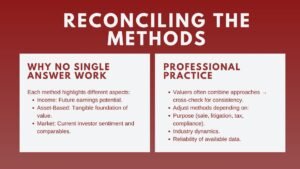
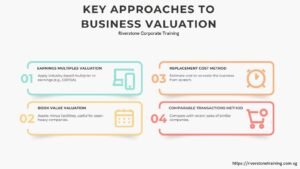
One of the main elements of the curriculum is valuation methodologies. Discounted cash flow analysis, market-based valuation methods, and asset-based perspectives are introduced to the participants and their application in the real world. The focus is put on the judgment, consistency, and adherence to professional standards instead of the application of mechanical formulas.
2.2 Practical Orientation and Real-World Relevance
The distinction between a good business valuation and financial modelling course and a standard academic course in finance is that of emphasizing on the real world. Case studies have been widely used in courses and are based on real-life transactions, corporate planning assignments or investment situations. The cases enable learners to appreciate how the valuation decisions are determined by the market conditions, the forces of competition, and the strategic purpose.
By use of repetition, the participants become confident in the model of how to structure them to be able to resist any questioning by senior management, investors, auditors or the regulators.
3. The Role of Free Business Valuation Courses in Early Learning
3.1 Accessibility and Foundational Knowledge
Free business valuation courses are a free entry point to valuation concepts and venturing into a finance-related occupation, as well as to the newcomers to the field. The primary concepts that are normally presented in these classes include the time value of money, fundamental valuation logic, and why financial models are important in decision-making. Even though they are not that deep, they are significant in developing conceptual clarity.
Free courses on business valuation are also taken by many professionals as a way of trying their interest in the profession before dedicating time and resources to an actual certification program. This discovery period may be of particular utility to students, entrepreneurs or non-finance workers.
3.2 Limitations of Free Learning Pathways
Although the free business valuation courses are helpful in the introductory level of learning, they are not typically structured, personal, and in-depth in terms of the case application. This means that only learners who have access to free resources might struggle to prove their competence when presented in a professional environment. That is why free courses can be considered as the first step to more specific training, like a course on financial modelling and business valuation or a professional certification.
4. Business Valuation Certificate Course as a Professional Credential
4.1 Why Certification Matters in Valuation Roles
A business valuation certificate course offers an acknowledgment of a valuation and modelling skill of a professional. In the competitive labor market, certification can be used as an indication of technical expertise, professional discipline, and professionalism. Clients and employers tend to view certification as being more reliable in terms of analysis and less risky in terms of execution.
In comparison to informal learning, a course in business valuation certificate usually involves the learner to prove applied competence by examinations, modelling tests, and case-based tests.
4.2 Alignment with Professional Standards and Best Practices
A lot of certificate programs have their curriculum based on known valuation schemes and global best practices. This will make sure that the learners are subjected to regular methodologies and ethical issues applicable in the professional practice. A business valuation certificate course with high weight is focused on the transparency of assumptions, rational model building, and justifiable valuation decisions.
The elements are especially crucial to the professionals, who are engaged in advisory work, since the results in valuation could affect the negotiations, financial reporting, or regulatory examination.
5. Application of Financial Modelling and Valuation in Practice
5.1 Corporate and Transactional Use Cases
The skills acquired as a result of the course on business valuation and financial modelling are used in a broader context of application in professional settings. Models are applied by corporate finance departments to calculate the capital investment opportunities and long-term strategic plans. Valuation models are used in making deals in mergers and acquisitions in valuing the deals, analyzing synergies and evaluating the performance of the acquisition after the acquisition.
It is important to note that modelling is used extensively by the private equity and investment professionals to estimate returns, determine the downside risk and comparing other prospective investment opportunities. In both of these situations, the role of combining modelling science and valuation is very important.
5.2 Enhancing Decision Quality Through Structured Analysis
One of the benefits of formal training via financial modelling and business valuation course is better quality of the decisions made. The structured models require decision-makers to formulate assumptions clearly, measure the uncertainty and trade-offs in a systematic manner. This analytical field makes use of less intuition and favors more transparent and evidence-based decision making.
6. Choosing the Right Business Valuation and Financial Modelling Course
6.1 Matching Course Design to Career Objectives
To choose the appropriate business valuation and financial modelling course, one should agree with personal career objectives. Individuals interested in advisory or transaction positions may choose courses that are highly rated in valuation and deal oriented case studies. Corporate individuals can request training programs based on forecasting, planning, and internal decision making.
It can also matter whether or not a course results in a business valuation certificate course credential which is formal and can be applied to other professionals who want to be externally recognized.
6.2 Evaluating Course Quality and Learning Support
The quality of the course is not only assessed by the areas of content coverage but also the way in which it should be taught and in what way the learners should be supported. Good quality programs have good explanations, systematic flow and have some practice opportunities. They also promote repetitive learning, which enables participants to enhance models through feedback and developping knowledge.
7. Long-Term Career Value of Valuation and Modelling Expertise
7.1 Continuous Skill Development Beyond Certification
Obtaining a certificate course in business valuation is a milestone not an endpoint. With the constantly changing markets and valuation practices to fit the new rules, technologies and business models, the professionals need to keep polishing their skills. A variety of them expand on their basis with the help of advanced modelling, special training in sector specific valuation, or incorporation of data analytics applications.
Continuous participation in valuation practice will make the knowledge acquired during the financial modelling and business valuation course critical and effective.
7.2 Career Progression and Professional Versatility
Professionals who have excellent valuation and modelling abilities tend to have a larger career mobility. The abilities gained during a course on business valuation and financial modelling can be applied across business sectors and business functions to facilitate the development towards senior finance, strategy, or advisory roles. This is flexibility and will increase career resilience in a more complex business environment in the long run.
Conclusion
Business valuation and financial modelling course is a strategic move towards those professionals who want to have a stronger impact on decisions and analytical skills. Although the free business valuation courses provide a good introduction, more competent students should develop deeper in-depth programs that bring together modelling discipline and valuation judgment. Formal validation of expertise is attained through the completion of a recognized course in business valuation and the course brings the professionals up to industry best practice.
The performance modeling and value assessment skills will be an essential professional resource as organizations require strict, transparent, and prospective financial analysis. Individuals who invest in systematic education in the field of financial modelling and business valuation are placed in the position to play a significant role in making business decisions and long-term value generation of high stakes.