
Professional Business Valuation Learning
Introduction to Professional Business Valuation Learning
Under a more competitive and data-driven business world, entrepreneurs, financial practitioners and corporate decision-makers should be allowed to estimate the value of companies precisely and objectively. Valuation is no longer a luxury; it is now a key requirement of investment analysis, mergers and acquisition, fundraising exercise, and strategic planning. Consequently, the demand of organized learning programs, including a small business valuation course, a business valuation short course and a corporate valuation online course, has increased dramatically in all international markets.
These courses present affordable, convenient, and practical educational options to professionals who need to develop or develop competence in the valuation tools, without investing in extended academic courses. In the first few steps, the participants are exposed to the fundamentals of valuation, and they build up the analytical rigor of the real world step by step. This paper focuses on the significance of a valuation education program, the comparison of various course delivery methods, and how one can choose the most appropriate program depending on a career goal.
The Growing Significance of Corporate Appraisal Skills.
Modern financial decision-making has Business valuation as its core. Valuation is a quantitative basis to strategic actions; whether it is the evaluation of the acquisition targets or the value to shareholders. Those professionals who complete a small business valuation course are prepared to value privately held companies, where the lack of available data and increased uncertainty demand valuation techniques.
Valuation capabilities are also very vital at the corporate level. Corporate valuation online course is very popular among the financial managers, consultants and executives in order to analyze capital investments, restructuring programs and long-term expansion plans. These skills contribute towards good decision making and minimize dangers that come with poor assumptions or incomprehensive financial analysis.
With regulatory scrutiny and investor demands becoming increasingly tougher, valuation expertise, too, has become a measure of professionalism and credibility in the finance-related positions.
Understanding a Small Business Valuation Course
The valuation course on small business is one that is specifically developed to consider the complexities of privately owned business. As opposed to the case of publicly listed companies, small businesses usually do not have transparent financial disclosures, standardized reporting procedures and liquidity in the market. As a result, financial statements that are adjusted, as well as the qualitative judgment and future projections, have to be used by the valuation professionals.
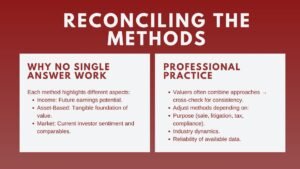
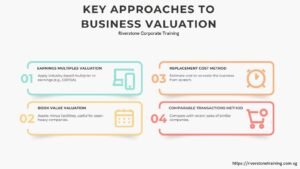
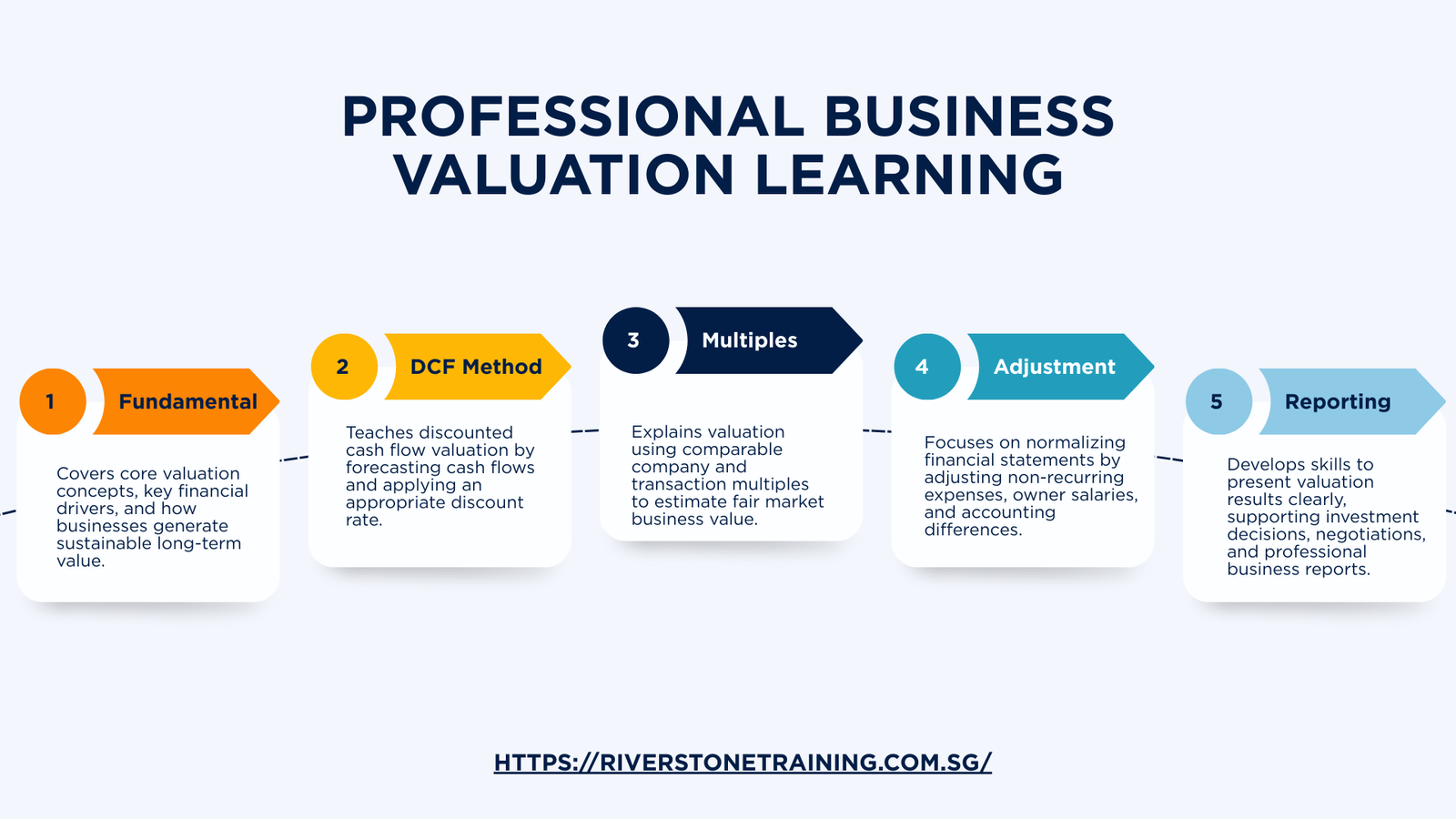
The people enrolling in a small business valuation course usually gain knowledge on how to use income based, market-based and asset based approach to valuation in small and medium-sized enterprises. Some of the critical areas of focus are the dependency of the owners, the concentration of the customers in terms of their number, the normalization of cash flows, and risk analysis. The programs are especially applicable to entrepreneurs, accountants, financial advisors and consultants who deal at close proximity with private businesses.
Besides technical methodologies, most courses also entail practical examples like business sales, succession planning and partnership disputes making them highly relevant in the real world.
Business Valuation Practical Value Short Course.
A business valuation short course provides a focused and effective way of learning to the professionals who require specific valuation knowledge but in a small duration. Such programs are designed in a way that they can present vital concepts of valuation without a lot of theoretical underpinning, which is ideal to busy professionals and those people who have not yet entered the practice of valuation.
Basic financial modeling, similar company analysis, and discounted cash flow analysis are core issues that are usually discussed during a business valuation short course. The summarized nature enables the students to learn valuation logic in a short period and implement it in simple business cases. This is why the short courses are particularly useful to managers, startup founders, and professionals who switch to jobs associated with finance.
Although they are shorter in time, most of the programs involve real-life case studies and practice examples. A business valuation short course, when properly designed, may be used as a valuable starting point with more advanced training on valuation or professional certification.
Most Important Advantages of a Corporate Valuation Online Course.
Corporate valuation online course is mostly offered to individuals engaged in corporate finance, investment banking, private equity or strategic management. These programs are based on the appreciation of bigger and multi-faceted organizations with diversified operations, capital market exposure, and regulatory factors.
The main benefit of having a corporate valuation online course is flexibility. Online provision allows the participants to maintain professional occupation and at the same time learn quality learning materials, professional teaching and engagement models on finance. This has flexibility which has helped increase the use of online valuation education amongst mid-level and senior professionals.
The course material is usually filled with some sophisticated financial modeling, scenario analysis, valuation of merger and acquisition, and sensitivity analysis. A properly designed online course on corporate valuation is also characterized by focusing on strategic interpretation, whereby a learner is able to transform the output of valuation into business action.
Comparing Learning outcomes and Valuation course formats.
A small business valuation course,, a business valuation short course, and corporate valuation online course selection are based on professional experience, learning purposes, and time. Both of the formats have different advantages and outcomes.
An SBC course would best suit an individual who works directly with privately held business or an entrepreneurial business. A business appraisal course is the fast-track course, which imparts skills to professionals who need urgent practical skills. In the meantime, an online course in corporate valuation provides an extensive training to the participants of the large-scale financial analysis and corporate decision-making.
Nevertheless, the differences do not eliminate the fact that the purpose of all valuation courses is the same, and that is to instill analytical discipline and financial literacy as well as confidence in making decisions involving valuation.
Skills Learned by Valuation Education.
Education on valuation is not just a mere numerical training. The transferable skills gained by the participants include financial statement interpretation, critical thinking, risk assessment and strategic judgment.
By taking a course in small business valuation, learners develop a skill of measuring more qualitative aspects like quality of management and market positioning. A business valuation course enhances the basics of analysis and financial reporting. In the meantime, an online course on corporate valuation enhances the strategic understanding of how professionals can assess more complicated business arrangements and long-term value generators.
Collectively, these skills will help in better financial judgment and better performance of the organization.
Valuation Courses and Career Development
One of the reasons why people enroll in valuation programs is career promotion. An entrepreneurship course, consulting, and advisory service opportunities could be opened by a. A small business valuation course. In the same way, business valuation short course can facilitate career changes or supplement an existing managerial position.
To learners seeking senior jobs in the field of finance, corporate valuation online course offer advanced skills that are congruent with the job requirements of an executive. The employers are more and more appreciating a candidate with structured knowledge of valuation and real application skills.
Formal valuation education is also a distinction credential in competitive job markets, being an indicator of dedication to life-long learning and professionalism.
The Right Choice of Valuation Program.
The information that potential students need to consider when deciding on the valuation course is depth of curriculum, quality of instruction, practical and certification. An accredited course on small business valuation must incorporate real-life studies and examples. The business valuation short course must be of high quality that underlines clarity, relevance, and applicability.
In the case of a corporate valuation online course, the most important factors are the level of financial modeling, the knowledge of the instructor, and meeting of industry standards. Majoring in a course that aligns with career objectives is a sure way of maximizing the investment of learning.
Conclusion
Conclusively, valuation skills have grown to be a requisite skill in the contemporary business world. Small business valuation course, a short course in business valuation, and online course in corporate valuation are some of the programs that provide structured and accessible ways of acquiring this important skill set. All the forms are designed to meet various professional requirements and lead to better financial intuition and decision-making skills.
The use of data-driven strategies is becoming a significant part of the work of organizations and investors, and full knowledge of valuation gives professionals a clear competitive edge. Proper choice of the valuation course, its application, can help learners speed up career development, increase business success, and become involved in long-term organizational success.