Business valuation courses cover DCF, allowing students to learn how to forecast the cash flow of the business, calculate the discount rates for the business, calculate present value, and interpret the results for investment, financial reporting, and strategic decisions. This is a step-by-step, hands-on training that develops the skills needed to model reliably in the real world.
What Is DCF Business Valuation?
A business valuation method that attempts to value a company based on what they think it’s worth in the future, calculated as the present value of its future free cash flows. It is based on the idea that a business is worth more than just any lump sum of cash, but the cash it can produce in the future adjusted for risk and the time value of money.
Let’s say an analyst were to value a manufacturing firm; he/she would forecast cash flows for the next five to ten years, and then discount the cash flows back to their present value at an appropriate discount rate. This method will directly link valuation to the company’s expected operating performance and not just market sentiment.
Why Is DCF Valuation Important in Business Valuation?
The significance of DCF valuation is to provide a fundamental basis and evaluate the value of a company based on its expected future profitability, as opposed to relying on market comparisons, which are distorted or may not exist. This is particularly helpful when there are not enough comparable companies to rely on.
For sale transactions, such as a private company, there may not be close public market comparables, so a DCF model may be the most defensible approach to support the proposed valuation. A DCF analysis is a common expectation when performing any serious valuation exercise, and is often requested by investors, lenders, and boards.
How Do Business Valuation Courses Teach DCF Valuation?
Business valuation courses break down the DCF valuation principle in a structured format, which includes lessons on forecasting, discount rate calculation, and terminal value; they then provide hands-on practice in modeling using real (or realistic) company data. Theory and practice are combined to develop conceptual understanding and technical modeling skill.
A typical module could include development of an entire DCF model for a company provided in a case study, from a historical financial statements to projections, and then discounting and sensitivity testing. This approach is based on cases and demonstrates the real-life workflow of analysts.
How Are Future Cash Flows Forecasted?
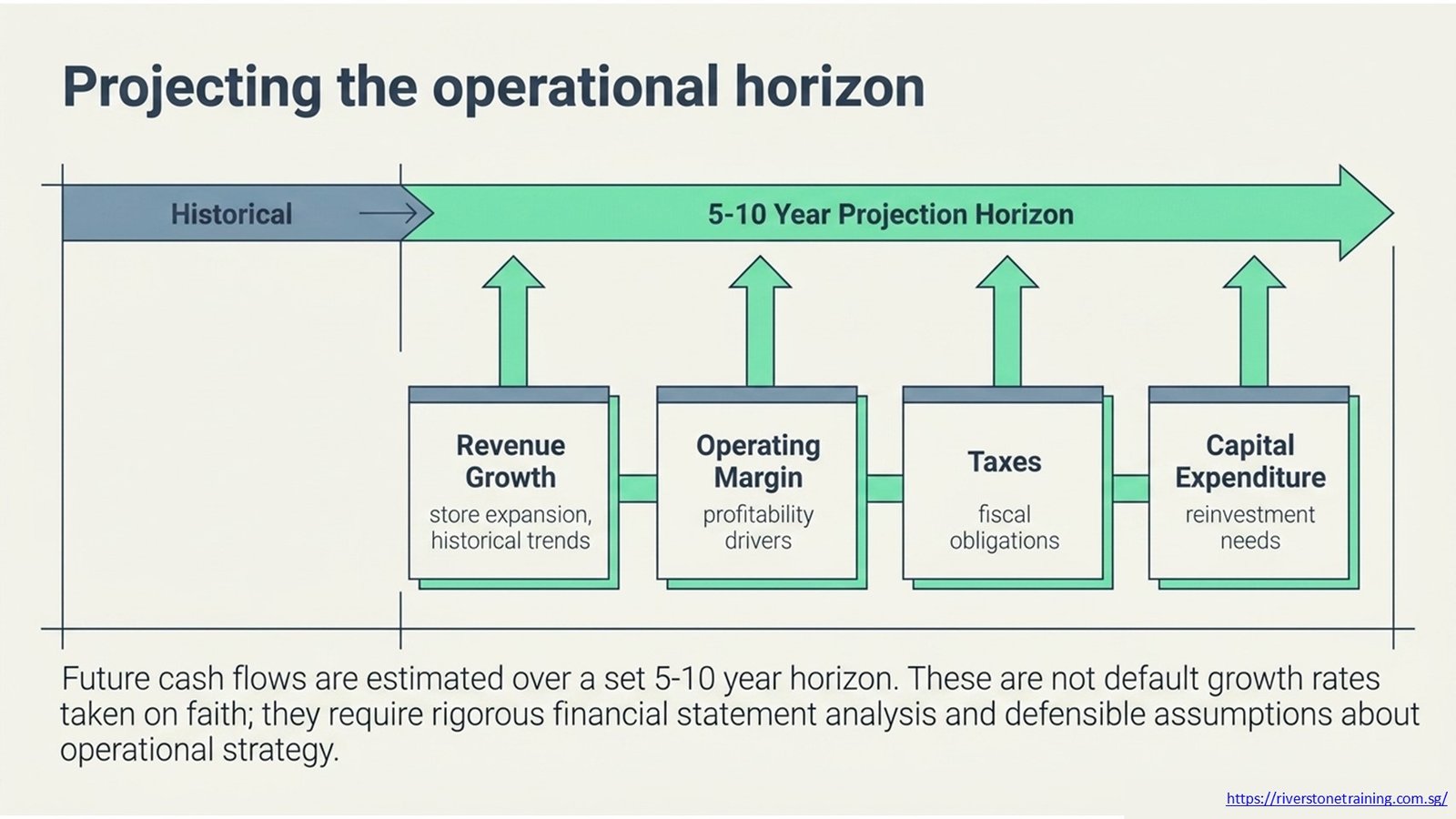
Future cash flows are estimated based on projected revenue growth, operating margin, taxes, and capital expenditure for a set forecast horizon, which is usually between 5 and 10 years. Typically, these forecasts are developed through financial statement analysis over an extended period of time and include assumptions about future performance.
For a retail business, the analyst predicting cash flow for such a company may create a model for revenue growth following store expansion strategies and historical same-store sales trends. Learners may be asked to explain each of the assumptions in course exercises rather than taking things on faith and accepting a growth rate as default.
How Is the Discount Rate Determined?
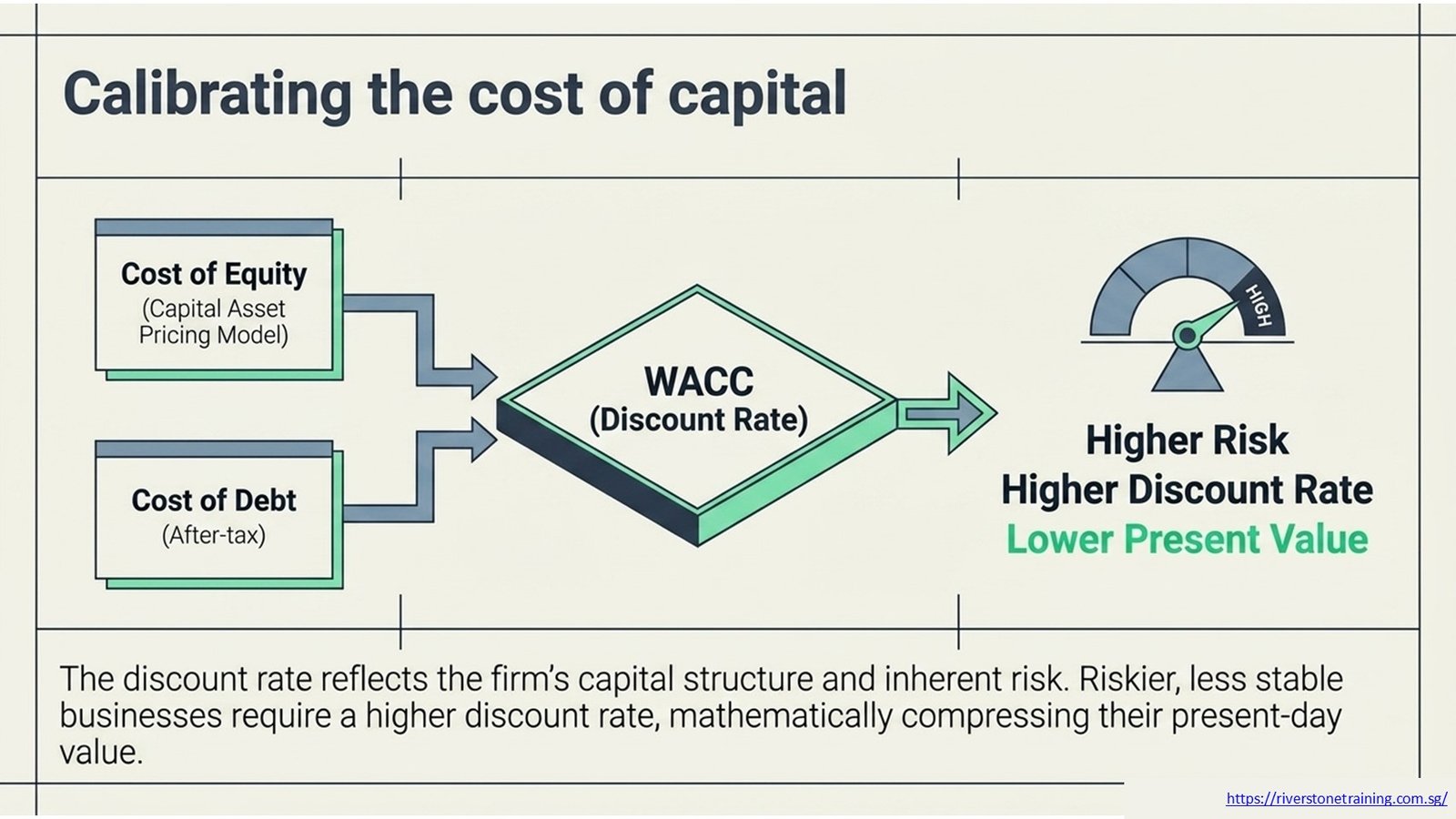
The discount rate is usually calculated as the weighted average cost of capital (WACC), which is the average cost of the firm’s debt and equity capital. A riskier business will get a lower discount rate, making its present value less than that of more stable businesses.
The calculation of WACC requires an estimation of the cost of equity (usually using the capital asset pricing model), as well as an estimation of the after-tax cost of debt. Through valuation courses, students will receive a step-by-step walkthrough of all the inputs, therefore understanding the impact of altering capital structure or risk assumptions on the final discount rate.
What Is the Role of Terminal Value in DCF Analysis?
Terminal value is the value of the business after the specific forecast period, typically making up the bulk of a DCF valuation. It is normally determined through a perpetuity growth technique or an exit-multiple technique.
A company that is likely to expand at a steady rate after year 10 may opt for a perpetuity growth rate similar to that of the expected long-term GDP growth, while a company that is expected to be sold may choose an exit multiple from comparable sales. Testing terminal value is so important that it is a focus of the course.
How Does Present Value Affect Business Valuation?
The present value has an impact on business valuation because it focuses on the value of expected future cash flows in the present time, taking into account the time value of money and the risks of investments. A dollar now is worth more than a dollar years later.
By discounting the cash flows for each year in the forecast period, including the terminal value, and adding them all together, the company’s enterprise value is determined. Analysts can use this relationship to provide an explanation as to why two companies with the same future cash flows might be valued very differently, depending on their risk characteristics.
How Is DCF Applied in Small Business Valuation?
DCF is applied in small business valuation by adapting standard forecasting and discounting techniques to reflect the limited financial history, owner dependency, and higher risk often present in smaller companies. These extra risks often mean that analysts will add to discount rates.
A small family-owned business might have less detailed financial information to look at than a larger business, so the analyst will have to make more assumptions using normalized earnings and reasonable industry benchmarks. It provides business valuation training that enables learners to understand when and how to apply reasonable adjustments to the general DCF assumptions for smaller companies.
How Do Analysts Validate DCF Assumptions?
Analysts then test the sensitivity of the DCF to changes in the key assumptions by comparing them to the history of the company, industry averages, and management expectations. This way, you will be less likely to take on numbers that are unsupported or too optimistic.
Very often, sensitivity analysis is used to validate the valuation, and it reveals how the valuation would change under various reasonable assumptions in terms of revenue growth, margins, or discount rate. Many times, learners are required to create a sensitivity table with their base-case model for course exercises to show this.
What Common Mistakes Should Be Avoided in DCF Valuation?
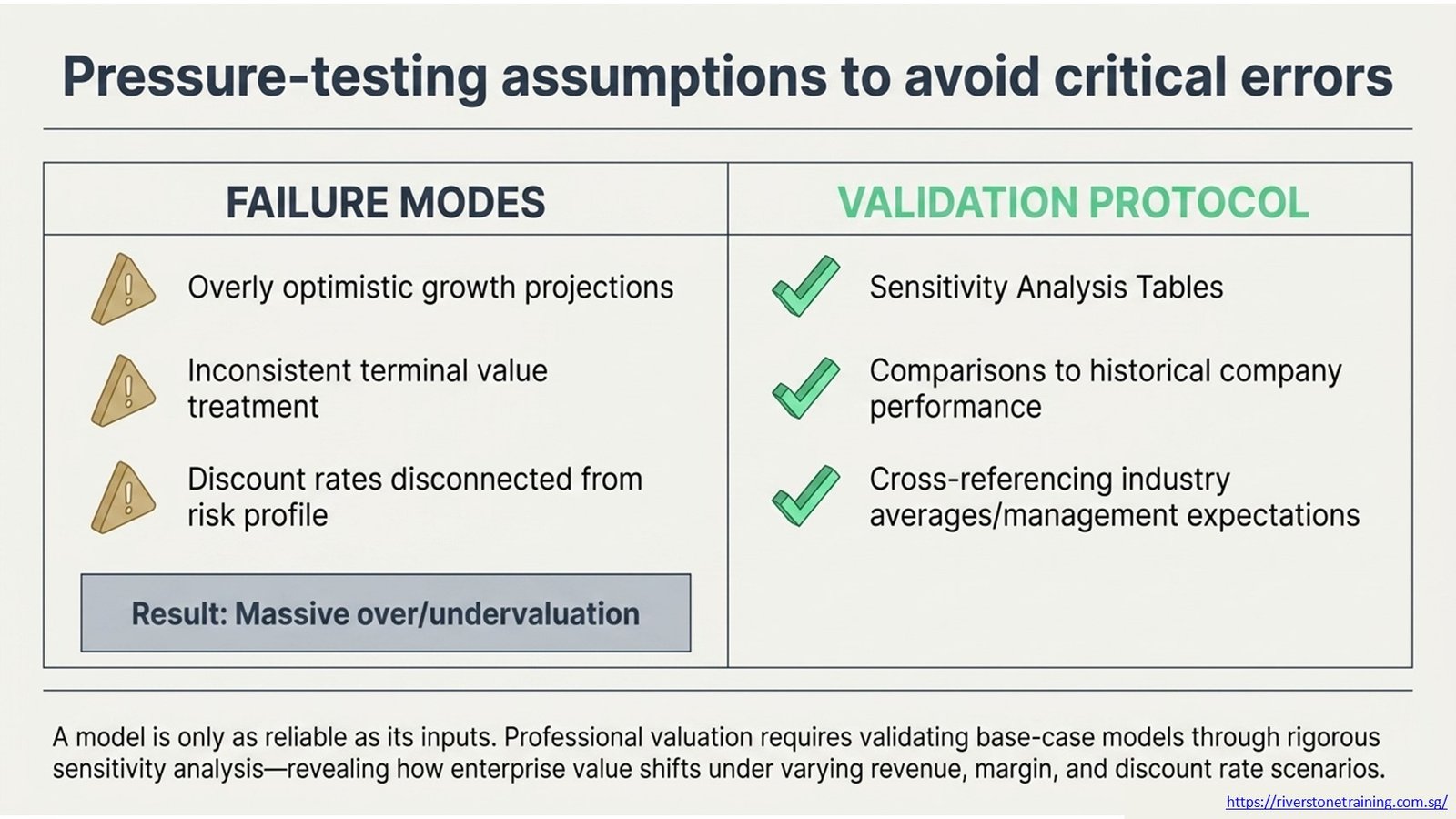
Common problems with DCF are overly optimistic growth projections, the failure to treat the terminal value consistently, and the use of discount rates that are not reflective of the company’s risk profile. These mistakes can greatly overvalue or undervalue a company’s real worth.
A common error is not to compare the DCF result with other methods of valuation (an opportunity missed to sanity check). The training in valuation focuses on verifying the assumptions and comparing the DCF outcomes with market-based valuation methods prior to reaching a final conclusion.
How Does DCF Compare with Other Business Valuation Methods?
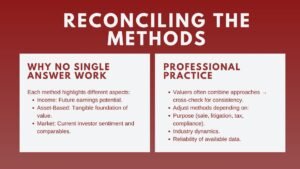
In contrast to other business valuation approaches that use information about similar companies and/or asset values, the DCF approach uses information about a company’s own projected cash flows. Every approach has its own advantages, depending on the business and information available.
For a stable, cash-generating business, DCF may be a suitable model for determining the appropriate valuation value, whereas for an asset-heavy business, such as a real estate holding company, it may be more appropriate to use an asset-based approach to determine the appropriate valuation value. Courses equip learners with the knowledge and skills to choose and combine methods suitably and do not expect them to just rely on one method.
What Practical Skills Are Developed Through Business Valuation Courses?
Business valuation courses build hands-on skills in financial statement analysis, sensitivity analysis, cash flow forecasting, and the calculation of discount rates. These skills are directly applicable to workplace valuation tasks.
A learner who has finished a course may be able to walk away with a portfolio of complete DCF models created from actual company filings, which he or she could present for job applications or client relationships. This practical output is a distinction between structured training and only theoretical study.
How Is DCF Used in Real Business Transactions?
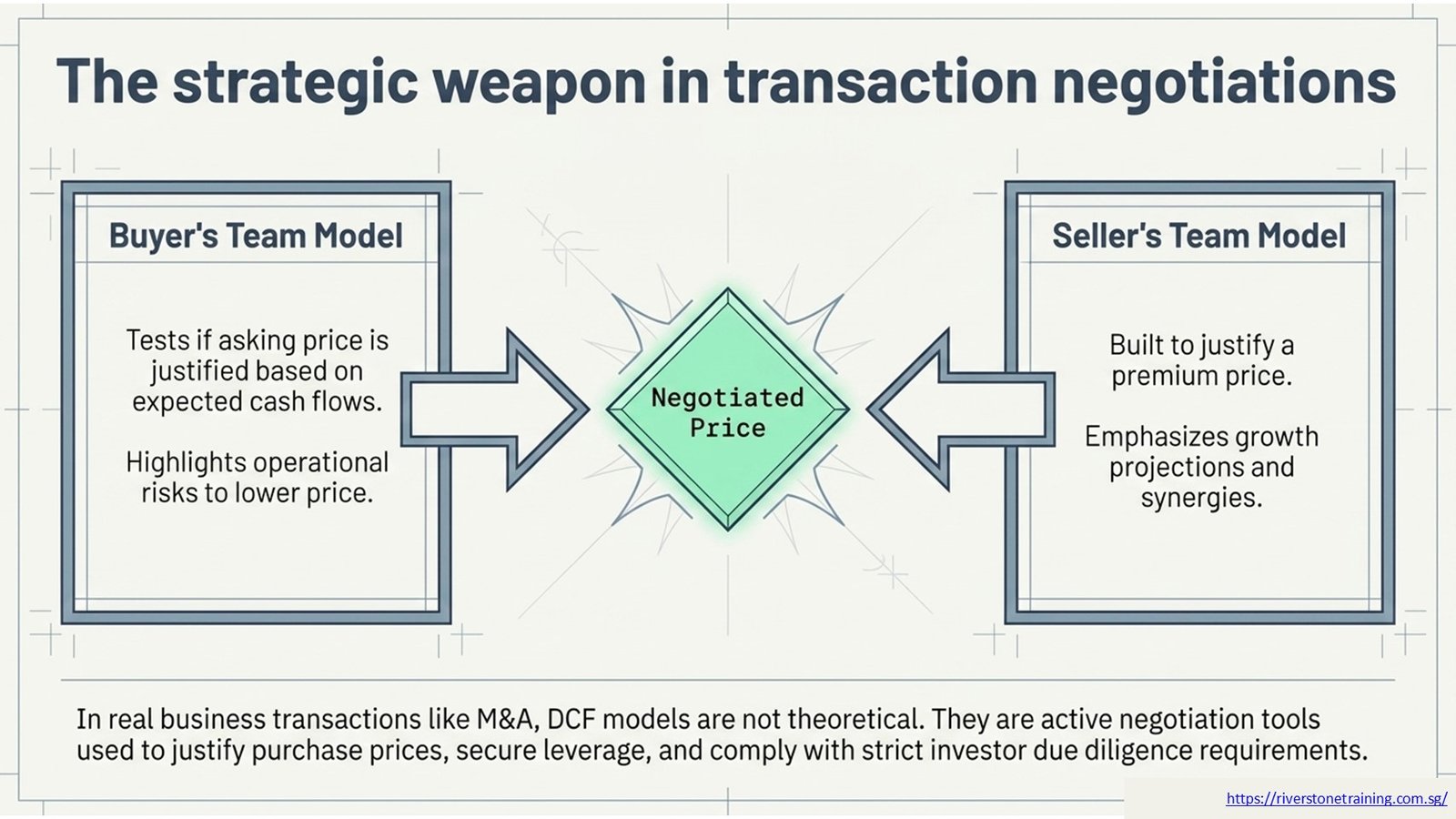
In real business transactions, they are used for negotiation, justifying purchase price, and complying with lender and/or investor’s Due Diligence requirements. It is usually incorporated into a comprehensive valuation report with similar company analysis.
During an acquisition, the buyer’s team may create a DCF to determine if the seller’s pricing is justified based on its expected cash flows, and the seller’s team may create its own DCF to justify the seller’s pricing. This is often a negotiated price affected by these competing analyses.
How Can DCF Valuation Skills Support Career Development?
Professionals who learn the skills of DCF analysis are well-positioned for a variety of career paths, including investment analysis, M&A and corporate finance, and valuation advisory, all of which require financial modeling as a daily part of the job. These skills are applicable in various industries and companies of different sizes.
If, for instance, one of your accountants masters strong DCF modeling skills, then they will qualify for transaction advisory or corporate development jobs, which can involve a more complex level of financial analysis than bookkeeping or auditing.
Why Is Practical Valuation Training Important?
It’s important to have practical valuation training because there are a lot of judgment calls made in the DCF model that you can’t just learn from theory, for example, determining the right growth rate for a business or the right discount rate. Hands-on practice helps to develop the confidence to make these calls properly.
Learners who study DCF business valuation through structured, case-based training gain direct experience building and defending valuation models, preparing them for the real analytical demands of valuation, finance, and advisory careers.
DCF Valuation Process
The table below outlines the core steps in building a DCF valuation model.
| Step | Purpose |
| Forecast Cash Flows | Estimate future business performance |
| Determine Discount Rate | Reflect investment risk |
| Calculate Terminal Value | Estimate value beyond the forecast period |
| Discount Future Cash Flows | Determine present value |
Key DCF Assumptions
Several core assumptions drive the accuracy and reliability of a DCF valuation.
| Assumption | Why It Matters |
| Revenue Growth | Drives future cash flows |
| Operating Margin | Affects profitability |
| Discount Rate | Reflects investment risk |
| Terminal Growth Rate | Influences long-term value |
DCF vs Other Valuation Methods
DCF is one of several valuation approaches, each suited to different business circumstances.
| Method | Best Used For | Main Focus |
| DCF | Stable businesses | Future cash flows |
| Market Approach | Comparable companies | Market pricing |
| Asset-Based Approach | Asset-intensive businesses | Net asset value |
Career Applications of DCF Valuation Skills
DCF modeling skills apply across a range of finance and valuation-related roles.
| Role | DCF Application |
| Valuation Analyst | Business valuation |
| Investment Analyst | Investment appraisal |
| Corporate Finance Professional | Strategic planning |
| M&A Advisor | Transaction analysis |
Summary: How Courses Build DCF Valuation Skills
The table below brings together the key elements of DCF training covered in this article.
| Element | Role in DCF Mastery |
| Cash Flow Forecasting | Projects future business performance |
| Discount Rate Calculation | Reflects risk in present value terms |
| Terminal Value | Captures long-term business worth |
| Assumption Validation | Builds credible, defensible models |
| Hands-On Practice | Develops real modeling competency |
Conclusion: Building Reliable DCF Valuation Skills
Business valuation courses focus on teaching the DCF valuation technique and involve hands-on practice in modeling, including using real-life case studies, alongside structured classroom instruction on forecasting, discount rates, and terminal value. Accurate projections of future cash flows, selection of the correct discount rates, verification of assumptions, and the correct interpretation of the results, with professional judgment, are essential to mastering DCF business valuation.
These abilities enable professionals to conduct accurate valuations in many different industries, and an awareness of the process of valuing small businesses enables them to tailor the skills for use in valuing different sizes and ownership of small businesses. Structured training and the practice of financial modeling are essential for developing comprehensive DCF expertise, which is a practical and career development approach for anyone involved in valuation, finance, or advisory.