How Can Startup Valuation Singapore Support Fundraising?

Founders should have a defensible startup valuation Singapore practice before making any approach to investors because the valuation directly impacts the amount of equity that the founders have to cede to investors for their investments.

A startup’s valuation isn’t just based on its current revenue or profit. A startup can be evaluated based on a number of factors, including growth potential, market opportunity, customer traction, financial performance, IP, and risk. 

Startup Valuation Singapore

Why Startup Valuation Is Different

The valuation of a startup company is quite different from the valuation of a mature and established business, and primarily due to the increase in uncertainty and lack of historical evidence that can be used to estimate the value of a startup company. 

Limited Financial History

For some startups, it may be a matter of just a few years, or even just a few months, of financial data from the past. When there’s not much of that history, it can be challenging to rely solely on it, and forecasts may be more important than they would be for an established company when deciding whether to assess. 

High Growth Assumptions

Investors will consider the scalability of a start up, which includes revenue growth, growth in customer base, expansion of the market, recurring revenue, unit economics, and margins going forward. Valuation can also be driven by high growth expectations, but it requires more than just assumptions, it requires supporting evidence. 

Intangible Assets

When assets like software, intellectual property, proprietary technology, data, brand and customer relationships are hard to value directly, they can have a significant impact on investor perceptions, even if they don’t show up in the numbers. 

Market and Execution Risk

Startup valuation needs to take into account uncertainty of competition, regulatory change, customer concentration, technology risk, funding requirements, management execution, and market adoption. Just because it has a big market opportunity, it does not mean that it is a high valuation on its own. 

What Determines Startup Valuation?

Revenue and Growth

It’s not just about current revenue or growth rates, recurring revenue, gross margin, customer acquisition, and revenue predictability are all important. The revenue of two startups can be the same, but they can have different valuations due to their growth stages, margins, markets and risk profiles. 

Market Size

Investors can use total addressable market (TAM), serviceable addressable market (SAM), and serviceable obtainable market (SOM) to assess the growth potential for the future. Founders should not provide a vague vision of a market from which the company would hope to gain a share, but should show how the company could actually achieve this. 

Customer Traction

These include paying customers, customer growth, retention, churn, repeat purchases, contract value and customer concentration. Real customer traction will be a far more compelling proof than unsupported growth projections. 

Intellectual Property

Patents, proprietary software, technology, trade secrets, and proprietary processes can be important, but IP does not necessarily equal a monetary value. It should be considered in terms of its commercial value, defensibility, and future economic benefits. 

Management Team

The investor evaluation of execution risk is affected by the founder experience, the industry knowledge, technical capability, commercial capability, track record and the ability to execute the growth plan. 

Startup Valuation Methods

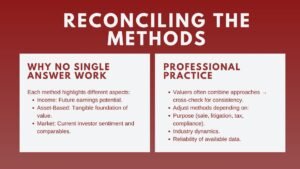
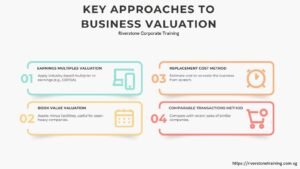
No one valuation tool is 100% effective for every startup. The right way varies with the stage of the startup, the level of its revenues, the presence of financial information, its business model, its industry, its growth curve, and the stage of the investment. 

Comparable Company Analysis

Comparable Company Analysis is a type of company analysis that uses common multiples (like EV/revenue, EV/EBITDA or P/E) across a mix of similar businesses, by industry, business model, revenue, growth, geography, scale, and profitability.

When comparing companies at different stages – not yet profitable – it may be more helpful to look at revenue-based comparisons instead of profit-based multiples. A startup with an annual revenue of S$2 million, for instance, may have an expected revenue multiple of 5, thus generating an estimated enterprise value of S$10 million (S$2 million x 5). This approach needs to be done carefully and using only appropriate and relevant comparables as a set – if the set is not appropriate and relevant, the result can be skewed. 

Discounted Cash Flow

In the DCF valuation model, the revenue, operating costs, EBITDA, taxes, capital expenditure and working capital are projected, which leads to the free cash flow, which is then discounted at a specific discount rate and summed with a terminal value.

For early-stage startups, DCF can be difficult to perform because relatively small variations in the assumptions can lead to variations in the valuation. Therefore, it is particularly significant to conduct sensitivity analysis, that is, how the result changes based on the growth, margin and discount-rate assumptions made. 

Venture Capital Method

The venture capital method assumes an exit value in the future, then calculates the expected investor return, discounts the future value back to the date of the investment and then estimates the implied post-money or pre-money valuation. An expected exit valuation of S$50 million and an investor’s target multiple of 5x means that the required exit value is S$10 million, which then helps to dictate today’s valuation. The targeting multiples and exit value are always based on assumptions, and should never be assumed as fact. 

Scorecard Method

The scorecard approach rates a startup against the management team, market opportunity, product, competitive environment, marketing and sales channels and the need for further investment. It takes a number of similar companies to the start-up to compare and adjust the value of the company depending on their strengths and weaknesses, which can be useful when financial information is scarce. 

Pre-Money vs Post-Money Valuation

Pre-money valuation is the company’s value immediately before the new investment. Post-money valuation is the company’s value immediately after the investment.

Consider a simple example: a pre-money valuation of S$8 million plus a new investment of S$2 million produces a post-money valuation of S$10 million.

Investor ownership = S$2 million ÷ S$10 million = 20%

Post-investment ownership of the company would be 80% in the hands of the founders. It’s crucial to have an understanding of this relationship before entering into a round of funding, because it directly impacts the amount of ownership the company founders will have in the venture. 

How Valuation Affects Founder Dilution

The relationship takes you from the valuation of the company to the amount of investment, the ownership of the investor, and the dilution of the founders. With everything else held equal, a higher pre-money valuation will mean a lower percentage of ownership that can be issued to the investor for the same investment. 

Item Scenario A Scenario B
Pre-money valuation S$8 million S$18 million
Investment S$2 million S$2 million
Post-money valuation S$10 million S$20 million
Investor ownership 20% 10%

In scenario A, if the valuation is S$8 million, 20% ownership will be gained with an S$2 million investment. In Scenario B, there is a pre-money valuation of S$18 million, and the investor will only own 10% of the company. But founders shouldn’t just look at the headline valuation: liquidation preferences, voting rights, convertible instruments, option pools, anti-dilution provisions and more can impact the fact of a round. This article is not intended as a substitute for legal advice, and legal advice should be obtained for the terms of any particular transaction. 

How Financial Statement Analysis Supports Startup Valuation

A financial statement review provides an insight into the company’s current financial situation for the founders and investors. The income statement includes revenue, cost of goods sold, gross profit, operating expenses, EBITDA and net income. The balance sheet reflects cash, receivables, payables, debt, working capital and equity. The cash flow statement is broken down into operating, investing and financing cash flow and cash burn. 

Financial statement analysis is particularly important for identifying whether reported growth is translating into sustainable financial performance rather than simply increasing revenue at an unsustainable cost.

While financial statement analysis is essential, the startup-specific metrics to accompany it are monthly recurring revenue, customer acquisition cost, lifetime value, burn rate, the startup’s runway, and gross margin. These metrics would be useful all by themselves, but should be used in addition to financial statement analysis. 

How Business Valuation Methods Apply to Startups

Traditional business valuation methods may need to be adapted when applied to early-stage companies, since the assumptions behind them were largely developed for businesses with established financial histories.

Method Best Used When Main Challenge
Comparable Companies Relevant peers exist Finding genuinely comparable businesses
DCF Forecasts are reasonably reliable High sensitivity to assumptions
VC Method Fundraising / high-growth startups Depends heavily on exit assumptions
Scorecard Limited financial history More subjective

Relying on a single number and business valuation method is not as defensible as presenting a valuation range when presented to investors, as using multiple methods together can provide a range of valuations. 

Example of a Singapore Startup Valuation

Consider a hypothetical Singapore-based SaaS startup with annual revenue of S$1.5 million, revenue growth of 40%, strong recurring revenue, positive gross margin, limited profitability, an established customer base, and significant growth opportunity.

Assuming comparable companies trade at approximately 4× revenue — a hypothetical assumption for educational purposes rather than a current Singapore market benchmark — the estimated enterprise value would be S$1.5 million × 4 = S$6 million.

Estimated enterprise value = S$1.5 million × 4 = S$6 million

A DCF estimate, a VC method estimate, and a scorecard method estimate may then be used to compare with the founder’s estimate. A valuation range, instead of S$6 million as a “last word” is more realistic and more believable to investors. 

Common Startup Valuation Mistakes

Overvaluing Based on Market Size Alone

While a large TAM can be a good indicator of revenue, investors will not take the number at face value, and will ask how the company will claim it. 

Using Unrealistic Growth Assumptions

Projections should not be made purely on an aspiration basis, but rather be backed up by historical performance, customer pipeline, market evidence, capacity and unit economics. 

Choosing Inappropriate Comparables

Not all large listed tech firms are a good direct comparable for an early-stage startup, as they have different scale, risk and profitability. 

Ignoring Cash Burn

Investors look at cash runway, capital needs, operating cash flow and future cash needs, not just growth. 

Focusing Only on Revenue

Gross margins, retention, customer concentration, unit economics, and growth quality all shape how sustainable that revenue actually is.

Treating One Valuation Method as Definitive

Usually valuing using multiple methods gives a stronger valuation range than valuing by a single method. 

What Documents Should Founders Prepare Before Valuation?

Well-structured and clear documentation in advance usually makes valuation discussions a lot more efficient. Founders should gather: 

  •       Historical financial statements
  •       Management accounts
  •       Revenue breakdown
  •       Customer data and growth metrics
  •       Business plan and financial projections
  •       Cap table
  •       Existing investment agreements
  •       Debt information
  •       IP information
  •       Market analysis

When Should Founders Get Professional Valuation Training?

Structured valuation training is useful for founders or finance professionals when they need to know valuation methodologies, financial analysis, forecasting, comparable company analysis, DCF, financial modelling, the assumptions of potential investors and the various fundraising scenarios and dilution calculations. 

A business valuation course can be particularly useful for founders who want to communicate more confidently with investors and finance teams, though structured training does not replace an independent professional valuation when one is required for a transaction, reporting purpose, dispute, or other formal use.

It might be valuable to any founder developing their own assumptions within their own office to improve their financial modeling abilities, and the same valuation concepts can be applied to an M&A valuation for an acquisition or a later-stage investor transaction. 

How Founders Can Prepare for Investor Valuation Discussions

Know Your Numbers

Know and comprehend the terms revenue, margins, burn rate, runway, and growth enough to be able to talk about them without hesitation. 

Understand Your Valuation Range

Never use a single valuation technique, instead, present a range of valuations with at least two valuation techniques. 

Prepare Supporting Evidence

Connect assumptions to actual business performance rather than presenting projections in isolation.

Understand Dilution

Be ready to understand what each dollar invested and valuation of the investment will mean for the founders’ ownership before you discuss negotiations. 

Be Ready to Defend Assumptions

Growth rates, margins, market size, customer acquisition costs, and exit assumptions are potential investor challenges. 

Separate Valuation From Negotiation

Fundraising is also a negotiation involving terms, investor demand, value and risk; and valuation is also an analytical assessment. 

Startup Valuation Preparation Checklist

☐  Gather historical financial statements

☐  Review revenue and growth

☐  Calculate key operating metrics

☐  Analyse cash burn and runway

☐  Identify comparable companies

☐  Prepare financial projections

☐  Estimate valuation using multiple methods

☐  Calculate pre-money and post-money valuation

☐  Assess founder dilution

☐  Prepare assumptions for investor questions

Conclusion of Startup Valuation Singapore

Valuing a startup before it goes out to raise funding is not just about picking a multiple, and creating one number. The financial performance, growth potential, market opportunity, traction, risk, valuation methodology and investor expectations are more tightly linked through a more defensible process. 

A sound approach to startup valuation Singapore requires founders to understand how their assumptions affect both valuation and dilution before entering fundraising discussions, and using several business valuation methods together can help create a more informed valuation range rather than a single, unquestioned figure. It is helpful for founders who are planning an investment round to brush up on their valuation and financial modelling before the discussion with investors. 
Frequently Asked Questions

How do you value a startup before fundraising?

Founders usually evaluate revenue and growth, market size, customer traction, management team, and IP and then use one or more of the valuation techniques to arrive at a sensible figure.

Revenue, growth rate, market opportunity, customer traction, intellectual property, management strength and overall business risk are among the factors that drive startup valuation Singapore.

No single best way. This cannot be done in the same way for every startup, and will vary depending on the stage and the financial and operating data that is available.

Financial statement analysis helps confirm whether reported growth is translating into sustainable financial performance, giving investors and founders a factual basis for valuation assumptions.

The main business valuation methods include comparable company analysis, discounted cash flow, the venture capital method, and the scorecard method, each suited to different stages and levels of data availability.

Pre Money Valuation is the company’s value before the new investment happens while Post Money Valuation is the value after the new investment has been added. For instance, if a company has a pre-money valuation of S$8 million, an investor puts in S$2 million before the company goes public, the post-money valuation will be S$10 million, with the investor owning 20% of the company. 

Founders should have a defensible startup valuation Singapore practice before making any approach to investors because the valuation directly impacts the amount of equity that the founders have to cede to investors for their investments.

A startup’s valuation isn’t just based on its current revenue or profit. A startup can be evaluated based on a number of factors, including growth potential, market opportunity, customer traction, financial performance, IP, and risk. 

Startup Valuation Singapore

Why Startup Valuation Is Different

The valuation of a startup company is quite different from the valuation of a mature and established business, and primarily due to the increase in uncertainty and lack of historical evidence that can be used to estimate the value of a startup company. 

Limited Financial History

For some startups, it may be a matter of just a few years, or even just a few months, of financial data from the past. When there’s not much of that history, it can be challenging to rely solely on it, and forecasts may be more important than they would be for an established company when deciding whether to assess. 

High Growth Assumptions

Investors will consider the scalability of a start up, which includes revenue growth, growth in customer base, expansion of the market, recurring revenue, unit economics, and margins going forward. Valuation can also be driven by high growth expectations, but it requires more than just assumptions, it requires supporting evidence. 

Intangible Assets

When assets like software, intellectual property, proprietary technology, data, brand and customer relationships are hard to value directly, they can have a significant impact on investor perceptions, even if they don’t show up in the numbers. 

Market and Execution Risk

Startup valuation needs to take into account uncertainty of competition, regulatory change, customer concentration, technology risk, funding requirements, management execution, and market adoption. Just because it has a big market opportunity, it does not mean that it is a high valuation on its own. 

What Determines Startup Valuation?

Revenue and Growth

It’s not just about current revenue or growth rates, recurring revenue, gross margin, customer acquisition, and revenue predictability are all important. The revenue of two startups can be the same, but they can have different valuations due to their growth stages, margins, markets and risk profiles. 

Market Size

Investors can use total addressable market (TAM), serviceable addressable market (SAM), and serviceable obtainable market (SOM) to assess the growth potential for the future. Founders should not provide a vague vision of a market from which the company would hope to gain a share, but should show how the company could actually achieve this. 

Customer Traction

These include paying customers, customer growth, retention, churn, repeat purchases, contract value and customer concentration. Real customer traction will be a far more compelling proof than unsupported growth projections. 

Intellectual Property

Patents, proprietary software, technology, trade secrets, and proprietary processes can be important, but IP does not necessarily equal a monetary value. It should be considered in terms of its commercial value, defensibility, and future economic benefits. 

Management Team

The investor evaluation of execution risk is affected by the founder experience, the industry knowledge, technical capability, commercial capability, track record and the ability to execute the growth plan. 

Startup Valuation Methods

No one valuation tool is 100% effective for every startup. The right way varies with the stage of the startup, the level of its revenues, the presence of financial information, its business model, its industry, its growth curve, and the stage of the investment. 

Comparable Company Analysis

Comparable Company Analysis is a type of company analysis that uses common multiples (like EV/revenue, EV/EBITDA or P/E) across a mix of similar businesses, by industry, business model, revenue, growth, geography, scale, and profitability.

When comparing companies at different stages – not yet profitable – it may be more helpful to look at revenue-based comparisons instead of profit-based multiples. A startup with an annual revenue of S$2 million, for instance, may have an expected revenue multiple of 5, thus generating an estimated enterprise value of S$10 million (S$2 million x 5). This approach needs to be done carefully and using only appropriate and relevant comparables as a set – if the set is not appropriate and relevant, the result can be skewed. 

Discounted Cash Flow

In the DCF valuation model, the revenue, operating costs, EBITDA, taxes, capital expenditure and working capital are projected, which leads to the free cash flow, which is then discounted at a specific discount rate and summed with a terminal value.

For early-stage startups, DCF can be difficult to perform because relatively small variations in the assumptions can lead to variations in the valuation. Therefore, it is particularly significant to conduct sensitivity analysis, that is, how the result changes based on the growth, margin and discount-rate assumptions made. 

Venture Capital Method

The venture capital method assumes an exit value in the future, then calculates the expected investor return, discounts the future value back to the date of the investment and then estimates the implied post-money or pre-money valuation. An expected exit valuation of S$50 million and an investor’s target multiple of 5x means that the required exit value is S$10 million, which then helps to dictate today’s valuation. The targeting multiples and exit value are always based on assumptions, and should never be assumed as fact. 

Scorecard Method

The scorecard approach rates a startup against the management team, market opportunity, product, competitive environment, marketing and sales channels and the need for further investment. It takes a number of similar companies to the start-up to compare and adjust the value of the company depending on their strengths and weaknesses, which can be useful when financial information is scarce. 

Pre-Money vs Post-Money Valuation

Pre-money valuation is the company’s value immediately before the new investment. Post-money valuation is the company’s value immediately after the investment.

Consider a simple example: a pre-money valuation of S$8 million plus a new investment of S$2 million produces a post-money valuation of S$10 million.

Investor ownership = S$2 million ÷ S$10 million = 20%

Post-investment ownership of the company would be 80% in the hands of the founders. It’s crucial to have an understanding of this relationship before entering into a round of funding, because it directly impacts the amount of ownership the company founders will have in the venture. 

How Valuation Affects Founder Dilution

The relationship takes you from the valuation of the company to the amount of investment, the ownership of the investor, and the dilution of the founders. With everything else held equal, a higher pre-money valuation will mean a lower percentage of ownership that can be issued to the investor for the same investment. 

Item Scenario A Scenario B
Pre-money valuation S$8 million S$18 million
Investment S$2 million S$2 million
Post-money valuation S$10 million S$20 million
Investor ownership 20% 10%

In scenario A, if the valuation is S$8 million, 20% ownership will be gained with an S$2 million investment. In Scenario B, there is a pre-money valuation of S$18 million, and the investor will only own 10% of the company. But founders shouldn’t just look at the headline valuation: liquidation preferences, voting rights, convertible instruments, option pools, anti-dilution provisions and more can impact the fact of a round. This article is not intended as a substitute for legal advice, and legal advice should be obtained for the terms of any particular transaction. 

How Financial Statement Analysis Supports Startup Valuation

A financial statement review provides an insight into the company’s current financial situation for the founders and investors. The income statement includes revenue, cost of goods sold, gross profit, operating expenses, EBITDA and net income. The balance sheet reflects cash, receivables, payables, debt, working capital and equity. The cash flow statement is broken down into operating, investing and financing cash flow and cash burn. 

Financial statement analysis is particularly important for identifying whether reported growth is translating into sustainable financial performance rather than simply increasing revenue at an unsustainable cost.

While financial statement analysis is essential, the startup-specific metrics to accompany it are monthly recurring revenue, customer acquisition cost, lifetime value, burn rate, the startup’s runway, and gross margin. These metrics would be useful all by themselves, but should be used in addition to financial statement analysis. 

How Business Valuation Methods Apply to Startups

Traditional business valuation methods may need to be adapted when applied to early-stage companies, since the assumptions behind them were largely developed for businesses with established financial histories.

Method Best Used When Main Challenge
Comparable Companies Relevant peers exist Finding genuinely comparable businesses
DCF Forecasts are reasonably reliable High sensitivity to assumptions
VC Method Fundraising / high-growth startups Depends heavily on exit assumptions
Scorecard Limited financial history More subjective

Relying on a single number and business valuation method is not as defensible as presenting a valuation range when presented to investors, as using multiple methods together can provide a range of valuations. 

Example of a Singapore Startup Valuation

Consider a hypothetical Singapore-based SaaS startup with annual revenue of S$1.5 million, revenue growth of 40%, strong recurring revenue, positive gross margin, limited profitability, an established customer base, and significant growth opportunity.

Assuming comparable companies trade at approximately 4× revenue — a hypothetical assumption for educational purposes rather than a current Singapore market benchmark — the estimated enterprise value would be S$1.5 million × 4 = S$6 million.

Estimated enterprise value = S$1.5 million × 4 = S$6 million

A DCF estimate, a VC method estimate, and a scorecard method estimate may then be used to compare with the founder’s estimate. A valuation range, instead of S$6 million as a “last word” is more realistic and more believable to investors. 

Common Startup Valuation Mistakes

Overvaluing Based on Market Size Alone

While a large TAM can be a good indicator of revenue, investors will not take the number at face value, and will ask how the company will claim it. 

Using Unrealistic Growth Assumptions

Projections should not be made purely on an aspiration basis, but rather be backed up by historical performance, customer pipeline, market evidence, capacity and unit economics. 

Choosing Inappropriate Comparables

Not all large listed tech firms are a good direct comparable for an early-stage startup, as they have different scale, risk and profitability. 

Ignoring Cash Burn

Investors look at cash runway, capital needs, operating cash flow and future cash needs, not just growth. 

Focusing Only on Revenue

Gross margins, retention, customer concentration, unit economics, and growth quality all shape how sustainable that revenue actually is.

Treating One Valuation Method as Definitive

Usually valuing using multiple methods gives a stronger valuation range than valuing by a single method. 

What Documents Should Founders Prepare Before Valuation?

Well-structured and clear documentation in advance usually makes valuation discussions a lot more efficient. Founders should gather: 

  •       Historical financial statements
  •       Management accounts
  •       Revenue breakdown
  •       Customer data and growth metrics
  •       Business plan and financial projections
  •       Cap table
  •       Existing investment agreements
  •       Debt information
  •       IP information
  •       Market analysis

When Should Founders Get Professional Valuation Training?

Structured valuation training is useful for founders or finance professionals when they need to know valuation methodologies, financial analysis, forecasting, comparable company analysis, DCF, financial modelling, the assumptions of potential investors and the various fundraising scenarios and dilution calculations. 

A business valuation course can be particularly useful for founders who want to communicate more confidently with investors and finance teams, though structured training does not replace an independent professional valuation when one is required for a transaction, reporting purpose, dispute, or other formal use.

It might be valuable to any founder developing their own assumptions within their own office to improve their financial modeling abilities, and the same valuation concepts can be applied to an M&A valuation for an acquisition or a later-stage investor transaction. 

How Founders Can Prepare for Investor Valuation Discussions

Know Your Numbers

Know and comprehend the terms revenue, margins, burn rate, runway, and growth enough to be able to talk about them without hesitation. 

Understand Your Valuation Range

Never use a single valuation technique, instead, present a range of valuations with at least two valuation techniques. 

Prepare Supporting Evidence

Connect assumptions to actual business performance rather than presenting projections in isolation.

Understand Dilution

Be ready to understand what each dollar invested and valuation of the investment will mean for the founders’ ownership before you discuss negotiations. 

Be Ready to Defend Assumptions

Growth rates, margins, market size, customer acquisition costs, and exit assumptions are potential investor challenges. 

Separate Valuation From Negotiation

Fundraising is also a negotiation involving terms, investor demand, value and risk; and valuation is also an analytical assessment. 

Startup Valuation Preparation Checklist

☐  Gather historical financial statements

☐  Review revenue and growth

☐  Calculate key operating metrics

☐  Analyse cash burn and runway

☐  Identify comparable companies

☐  Prepare financial projections

☐  Estimate valuation using multiple methods

☐  Calculate pre-money and post-money valuation

☐  Assess founder dilution

☐  Prepare assumptions for investor questions

Conclusion of Startup Valuation Singapore

Valuing a startup before it goes out to raise funding is not just about picking a multiple, and creating one number. The financial performance, growth potential, market opportunity, traction, risk, valuation methodology and investor expectations are more tightly linked through a more defensible process. 

A sound approach to startup valuation Singapore requires founders to understand how their assumptions affect both valuation and dilution before entering fundraising discussions, and using several business valuation methods together can help create a more informed valuation range rather than a single, unquestioned figure. It is helpful for founders who are planning an investment round to brush up on their valuation and financial modelling before the discussion with investors. 

Frequently Asked Questions

How do you value a startup before fundraising?

Founders usually evaluate revenue and growth, market size, customer traction, management team, and IP and then use one or more of the valuation techniques to arrive at a sensible figure.

Revenue, growth rate, market opportunity, customer traction, intellectual property, management strength and overall business risk are among the factors that drive startup valuation Singapore.

No single best way. This cannot be done in the same way for every startup, and will vary depending on the stage and the financial and operating data that is available.

Financial statement analysis helps confirm whether reported growth is translating into sustainable financial performance, giving investors and founders a factual basis for valuation assumptions.

The main business valuation methods include comparable company analysis, discounted cash flow, the venture capital method, and the scorecard method, each suited to different stages and levels of data availability.

Pre Money Valuation is the company’s value before the new investment happens while Post Money Valuation is the value after the new investment has been added. For instance, if a company has a pre-money valuation of S$8 million, an investor puts in S$2 million before the company goes public, the post-money valuation will be S$10 million, with the investor owning 20% of the company. 

Related Posts

Complete Guide Everything You Need to Know About Business Valuation Training

Learn Business Valuation in Singapore – Everything You Need to Know, Contact Us Now