A simple revenue or profit multiple to value a small business in Singapore is a rarely used method. This depends on the performance of the business, cash flow, assets, debt, business risk, growth potential, and, most importantly, the reason for the valuation.

What Is Small Business Valuation?
Small business valuation is an estimation of a small business’s worth, which is derived from its assets, risks, and the prospects for the future. It is easy to think of this in terms of a number based on revenue figures, but revenue is only an indicator of what a customer, investor or shareholder might really be willing to pay for. The value of two companies with the same turnover can differ significantly if taking into account the profitability, the risk, and the sustainability of earnings.
Why Small Businesses Are Different
There are a number of practical differences between SME valuation and valuation of large companies. Small businesses are more likely to be smaller, need to rely more on the owner, and may lack management depth beyond the owner. Revenue is typically highly concentrated in one or a few customers, and the company is typically privately held, making it harder to find information for comparison on the public markets. The nature of working capital patterns and the risks associated with a particular location or a key supplier or key employee in a business also tend to be more important. The approach to valuation has to take these true parameters, and not the assumptions made for listed companies.
What Determines the Value of an SME?
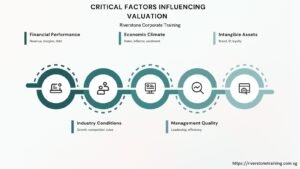
Revenue, profitability, EBITDA, cash flow, growth, percentage of recurring revenue, quality of customers, industry conditions, competitive position, assets, liabilities, debt, business risk and management structure are the key drivers of SME value. These are some of the considerations that can cause two businesses with similar revenue streams to be valued differently — one business may have a single large customer and thin, erratic margins, while the other has a diverse customer base, healthy margins, and a management team that’s not 100% reliant on the founder.
Enterprise Value vs Equity Value
There are two terms that frequently appear in business valuation discussions in Singapore, and it is important to be clear on what each one entails. The value of the operating business (excluding certain financing-related items) is called enterprise value. Equity value is the value assigned to equity after debt, cash and other items are deducted from enterprise value.
Equity Value = Enterprise Value − Debt + Cash
In reality, the adjustments to the valuation needed for actual transactions are more involved and could include shareholder loans, non-operating assets or working capital targets, but this is a good initial indicator for business owners to understand the impact of the headline valuation on what they would be given.
| Concept | Meaning |
| Enterprise Value | Value of the operating business before relevant financing adjustments |
| Debt | Financing obligation deducted in the simplified bridge |
| Cash | Cash added in the simplified bridge |
| Equity Value | Value attributable to shareholders after relevant adjustments |
How to Value a Small Business Step by Step
Review Historical Financial Statements
First steps in any credible valuation are an examination of income statements, balance sheets and cash flow statements, the revenue history, gross margins, operating expenses, EBITDA, working capital, debt and cash. Where practicable, this review should include a number of years of financial data and not just one year. The multi-year statements allow trends, volatility, one-off events, profitability patterns and financial risks to be identified that would not be apparent in snapshots.
Normalise Revenue and Earnings
Earnings may be reported in a manner that is not necessarily the sustainable economics of a small business, especially if the owner has set up compensation, expenses or transactions to benefit his personal tax situation more than a future buyer’s. Common normalisations are non-recurring transactions, personal expenses of the owner charged to the Company, compensation of the owner, one-off legal expenses, extraordinary expenses, unusual repairs and related party transactions. Normalisation should always have reasonable supporting evidence as well as being related to the objective of the valuation — not anything that the owner might wish to add back to profit or loss will be correct in isolation, and an over-enthusiastic approach will make the whole exercise difficult to believe.
Select the Appropriate Valuation Method
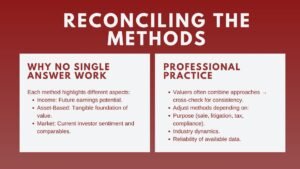
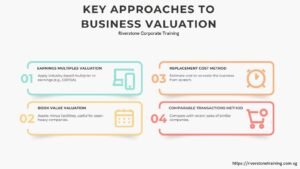
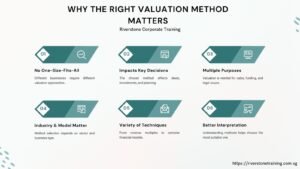
No one valuation approach is right for all SMEs. This will depend on the nature of the business, the accuracy of the financial data, the industry, profitability, asset size, growth projections and the intention to value the business and its assets. In practice, three broad approaches cover the vast majority of cases: the IFRS 13 Fair Value Measurement and the asset approach. Business valuation methods are structured to provide professionals with experience and practice in each method as it applies to various industries.
Apply Relevant Valuation Multiples
The most common metrics that are used in market-based multiples are EBITDA, earnings, and revenue. Choosing the right multiple is a judgment call and is dependent on a variety of factors, such as growth, profitability, risk, recurring revenue, customer concentration, industry conditions, business size, and dependency on the owner/management team. No industry or circumstance is universal when it comes to SME multiples, so two businesses within the same industry can expect to lure in different multiples once these factors are taken into consideration.
Adjust for Debt, Cash and Other Assets
After the estimation of an enterprise value, the analysis continues on the path of the equity value by adjusting bank debt, shareholder loans, cash, excess cash, non-operating assets, etc. and other liabilities. The specific treatment of each item will vary by valuation basis used and by the nature of the transaction; a valuation prepared for a shareholder dispute may value certain items differently than a valuation prepared for an acquisition.
Which Valuation Methods Work Best for SMEs?
There is no one better approach to valuation than another, depending on the characteristics and purpose of the valuation.
EBITDA Multiple
An EBITDA valuation uses a multiple of normalised EBITDA to arrive at an enterprise value:
EBITDA × Selected Multiple = Enterprise Value
The chosen multiple is affected by the growth potential, profitability, risk, recurring revenue and similar transactions in the same field. EBITDA multiples are common in SMEs since EBITDA is an approximation of operating cash flow and makes it possible to make reasonable comparisons between businesses that have different capital structures. The primary drawback is that they need to be judged and a slight shift in the chosen multiple will shift the valuation a greater distance.
Revenue Multiple
A revenue multiple may be appropriate when revenue is fairly predictable, profit margins are quite different within the comparable group, comparable companies in the industry typically appraise using revenue, or profitability is temporarily reduced due to some factor separate from the quality of the business itself. The big problem with revenue is that margins vary significantly between businesses, and applying a revenue multiple to a group of businesses with substantially different cost structures is bound to give a warped view of relative value.
Discounted Cash Flow
The discounted cash flow, or DCF, method is a method of valuing a business based on the expected future cash flows. This includes developing revenue projections, estimating the operating costs, calculating free cash flow, choosing a discount rate, calculating a terminal value, etc., which are then discounted to present value. When a business can have reasonably accurate projections and future cash flows (such as a business with long-term contracts or regular, repetitive revenue (recurring revenues), DCF may be especially beneficial. The most significant drawback of its sensitivity is the fact that both the growth rate and the margin estimates can vary significantly based on the assumptions for the discount rate, with the result of DCF analysis changing materially as a result.
Asset-Based Valuation
An asset-based approach could be more applicable when the value of a business is heavily tied to its tangible or identifiable assets (property, equipment, inventory, receivables and other assets less the liabilities). This approach is not likely the best solution for asset-light companies with high customer, brand, IP or future earning value.
| Valuation Method | Main Basis | Best Suited For | Key Limitation |
| EBITDA Multiple | Operating earnings | Profitable SMEs | Multiple selection |
| Revenue Multiple | Revenue | Certain revenue-driven businesses | Ignores margins |
| DCF | Future cash flows | Businesses with forecastable cash flows | Sensitive to assumptions |
| Asset-Based | Net assets | Asset-heavy businesses | May understate intangible value |
None of these techniques is consistently better than the others — a defensible valuation may require more than one technique, and multiple values may be reconciled.
What Can Increase or Reduce an SME’s Value?
But the value of a company isn’t only determined by past financial results, but also by the quality and durability of its future earnings.
Customer Concentration
Having a few large customers makes business riskier, as a loss of one or more large customers may materially impact profit. Purchasers are generally interested in the percentage of business derived from key customers, length and strength of customer contracts, customer retention rates, switching costs, and the overall diversified nature of customers.
Recurring Revenue
Subscription revenue, maintenance contracts, long-term service contracts, and repeat customer relationships are examples of recurring or predictable revenue, which can enhance expectations regarding cash flows. While this won’t necessarily drive up the value, it does make it easier to negotiate a better valuation, as the buyer can have greater confidence in the revenue compared to one-off or project-based revenue.
Owner Dependence
If a business is highly dependent on the founder to manage relationships with clients, make decisions, make sales, deal with suppliers, or know how to operate, then there is increased risk of transition — what will happen to the business when the founder leaves? This risk can be mitigated by the depth of the management and documented processes, in that management can show that a business can continue to operate without any one individual.
Intellectual Property
Business value can be derived from software, trademarks, proprietary processes, patents, databases and proprietary technology. Intangible assets should be measured for value by their economic benefit — the revenue or margin benefit that they actually generate — not on the basis that their mere presence is bound to generate value.
Growth Prospects
Market growth, trends in customer acquisition, pricing power, introduction of new products, geographic expansion, scalability and competitive advantages, all play a role in a buyer’s assessment of future potential. It is important to separate out historical performance from future growth expectations, which are, by nature, more fraught with uncertainty and require a basis other than optimism.
| Factor | Potential Impact on Value |
| Recurring Revenue | Can improve earnings predictability |
| Customer Concentration | Can increase risk |
| Owner Dependence | Can create transition risk |
| Growth Prospects | Can influence future value |
| Strong Margins | Can support profitability |
Example of a Small Business Valuation
The following is a simple example, made up of hypothetical facts, to demonstrate the mechanics of moving from EBITDA to enterprise value and then to equity value. This is an educational example and is not intended to be a representation of a suitable valuation multiple for Singapore SMEs and should not be considered as a true market valuation.
Consider a hypothetical Singapore SME with the following figures:
- Revenue: S$2,000,000
- Normalised EBITDA: S$300,000
- Selected EBITDA multiple: 5×
- Debt: S$250,000
- Cash: S$100,000
Enterprise Value = S$300,000 × 5 = S$1,500,000
Equity Value = S$1,500,000 − S$250,000 + S$100,000
Equity Value = S$1,350,000
This is an education exercise — it’s not a defensible valuation of an actual business company; it’s an explanation of the arithmetic of the bridge from EBITDA to equity value. In reality, the results achieved by the customer may vary significantly depending on customer concentration, growth, the risk of the industry, quality of earnings, management reliance, the percentage of recurring revenue, similar transactions in the industry, and the composition of the business’s debt.
Singapore-Specific Context for SME Valuation
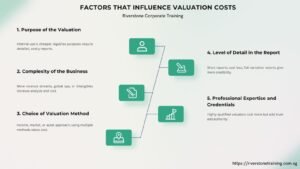
Some of the common scenarios where SME valuation in Singapore comes in are business sales, acquisitions, engaging investors, shareholder transactions, succession or ownership transfer, financial reporting, tax, and disputes. The purposes for each of these may require a different basis for valuation, and different degrees of rigour — an informal valuation for the purposes of guiding a founder’s expectations is an entirely different process than an informal valuation to support a formal transaction or dispute.
The Chartered Valuer and Appraiser programme is a professional qualification programme set by ACRA on behalf of the Institute of Valuers and Appraisers Singapore (IVAS), and is recognised against international valuation standards in Singapore. This provides a reference for business owners on how much rigour and professional accountability goes into a formal, credentialed valuation, especially when it has real transaction, reporting or tax implications. The information provided in this article is not legal or tax information and business owners with specific regulatory or tax-related questions should obtain the necessary professional advice.
The SME Valuation Process at a Glance
| Step | Key Question |
| Financial Review | What has the business historically earned? |
| Normalization | What earnings are sustainable? |
| Method Selection | Which approach fits the business? |
| Valuation | What does the selected method indicate? |
| Adjustments | What debt, cash, or other items need consideration? |
| Review | Are the assumptions reasonable? |
When Should a Business Owner Get a Professional Valuation?
In most cases, professional valuation assistance is worthwhile, as when you are selling a company, buying a company, making the company available to investors, settling disagreement among your shareholders, restructuring your company, planning for your company’s succession, reporting on financial matters, or when you need to support your valuation with defensible assumptions that a buyer, the auditor, or the court will agree to.
Professional valuation is even more valuable when there are financial, legal, tax or transaction consequences that have significant value — such as when the owner is preparing to sell the business, negotiating a transaction with an investor or a shareholder exit. For those involved in the world of business finance, business owners, and even aspiring business valuation practitioners, a structured business valuation course provides a way to learn valuation methodologies in depth and apply them with more confidence, rather than relying solely on external advisors for every valuation question that comes up.
It’s also important to grasp the general concepts of company valuation since many of the same concepts (enterprise value, equity value, normalised earnings, income approach, market approach, and asset approach) are the same whether the company is a small, owner-operated firm or a much larger company managed by professional management.
Conclusion of Valuing Small Business in Singapore
What is the valuation of a small business in Singapore? It’s all about looking at the financials, normalising earnings, choosing the right valuation method for the business, plugging in the right valuation multiples, adjusting for debt and cash holdings, and evaluating the business-specific risks and opportunities.
There is no shortcut in valuing a small business in Singapore, and it depends on the unique qualities, financial results, risks and future prospects of the specific business. In situations where there are consequential transaction, investment, reporting, tax or ownership implications, professional valuation expertise is very useful. A structured course on business valuation provides a practical approach for professionals and business owners to acquire knowledge of business valuation over time to make them stronger and more independent.