How Do Business Valuation Courses Prepare You to Value a Business for Sale?

Business valuation courses educate professionals on how to value a business for sale and provide an understanding of the methods of valuation, analysis of financial statements, market comparisons, and pricing strategies that are followed in business transaction practice. The structured training also helps develop negotiation skills to support valuation and decision-making throughout a business sale. 

What Does It Mean to Value a Business for Sale?

Business valuation when a business is on the market involves determining a defensible and objective price range, depending on the financial performance, assets, and market. The number is used to begin negotiation between buyer and seller.

A sale valuation is different from a valuation for internal planning or tax reasons, and it needs to be able to withstand buyer due diligence and scrutiny. The point is, a business owner can’t just base a price on feelings of emotional attachment, or on an investment made in the past; there must be real, tangible financial reasons for the price. 

Why Is Business Valuation Important Before Selling a Business?

Value a Business for Sale

Before selling a business, business valuation is critical, as if the listing price is too high, no buyer will want the business, and if the listing price is too low, the seller will be giving away profits that have been earned on the business over the years. The accurate valuation sets realistic expectations from the beginning of the sale process.

A sound valuation also helps to facilitate negotiations, as buyers are more inclined to take the negotiation process seriously when they have a solid financial basis for the asking price. Without this step in place, it’s likely that the seller will be negotiating for a long time or lose credibility when the buyer’s investigation reveals a different figure. 

How Do Business Valuation Courses Teach Business Valuation for Sale?
Value a Business for Sale

Business valuation courses teach business valuation for sale through a structured combination of valuation theory, financial modeling exercises, and applied case studies based on real transaction scenarios. Students are guided through learning about different valuation techniques, then using them in combination in one business case.

Usually, the course exercises ask the student to prepare a valuation report using the financial statements presented in the raw form, and then, either as a buyer or as an advisor, they have to argue their findings against the other party. This is similar to the pressure-tested rationale necessary in a real transaction of a business sale. 

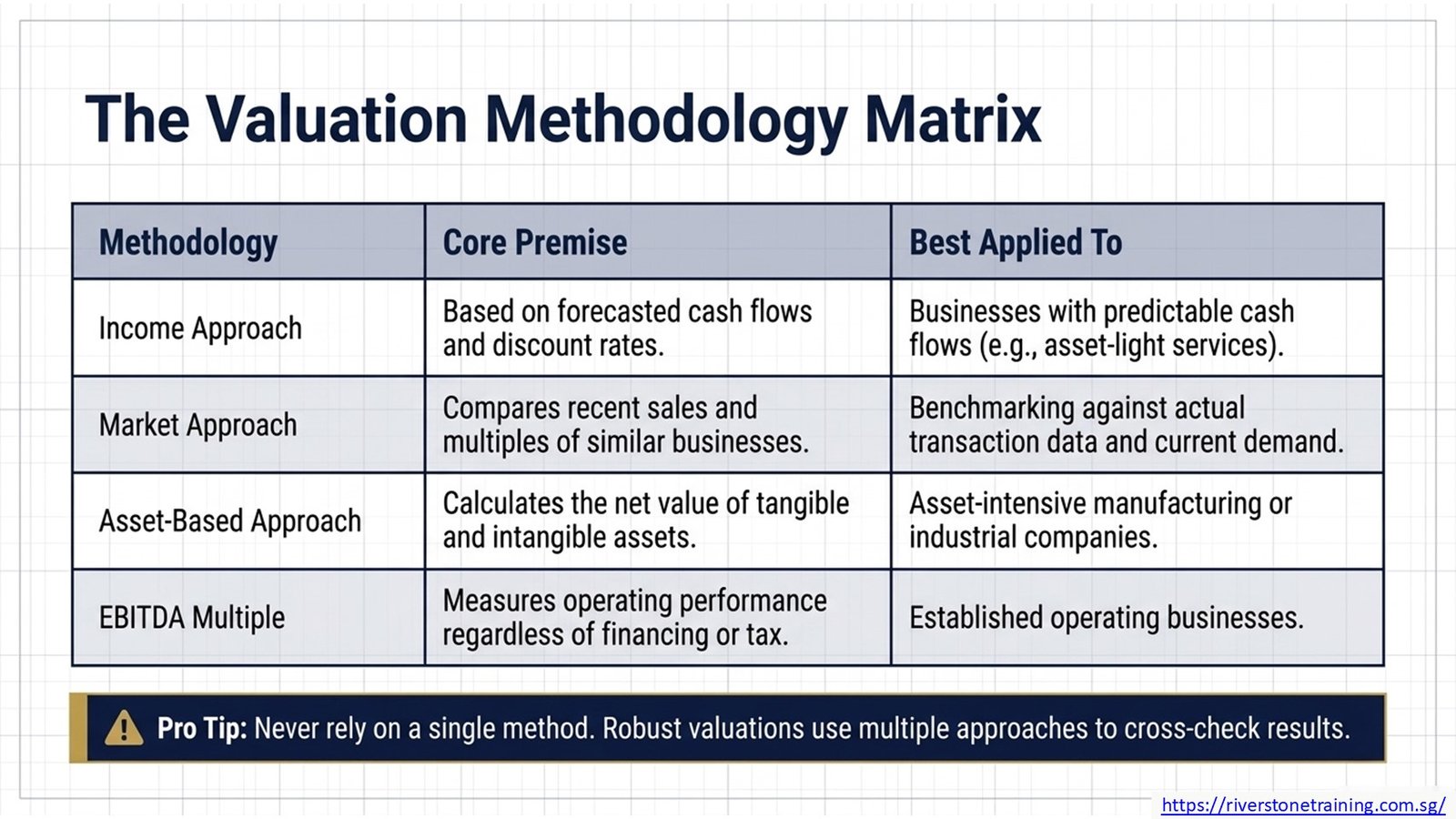
Common valuation methods taught in these courses, and where each is best applied, are summarized below:

Method Best Used For
Income Approach Businesses with predictable cash flows
Market Approach Comparing similar businesses sold recently
Asset-Based Approach Asset-intensive companies
EBITDA Multiple Established operating businesses

Which Valuation Methods Are Commonly Used?

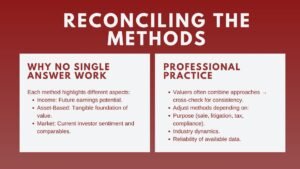
When a business is being valued for sale, the three main methods used are the income approach, the market approach, and the asset-based approach. Each method is based upon a different data set, so more than one method may be used to cross-check results.

The income approach is based on cash flows and the discount rate; the market approach compares recent sales of similar businesses; the asset approach assumes a valuation of the company’s tangible and intangible assets. For example, the valuation of an asset-light services company is generally carried out using the income approach and not the asset approach. 

How Are Financial Statements Analyzed During a Business Sale?

Financial statements are examined from a historical perspective to see if the revenue has been increasing, if the profit margins are healthy, and if the cash flow has been consistent to see if reported results are a true reflection of the earning power of the business. One-time or owner-specific costs that would not occur if the company were sold to a new owner are also excluded from analysts’ calculations to create the normalized figure.

The figure of EBITDA is one of the most important numbers included in this analysis, as it enables a buyer to compare the operating performance of businesses regardless of the way they finance or tax. A company that has good revenue numbers but is seeing its EBITDA margins declining is a tip-off that the costs are going up, and the buyer will want to understand why before accepting the offer. 

How Do Market Comparisons Improve Business Valuation?

Market comparisons enhance business valuation because a valuation is based on actual transaction data and not solely on theory. Comparable company analysis involves examining sale prices and multiples of other businesses that are similar to the company and of a comparable size.

This process can be very helpful when determining if an asking price is realistic in today’s market. A seller’s asking price should take into consideration the market demand for comparable businesses in a sector that may be selling at lower multiples, but not obsolete ones. 

What Factors Influence the Selling Price of a Business?

Revenue growth, profitability, customer concentration, market position, and recurring income are factors that affect the selling price of a business. Customers value companies with consistent and diversified revenue streams and a competitive advantage.

Other factors are important, such as the quality of management, documented processes, and the extent to which the business relies on the owner. A company that needs its founding owner to run it day-to-day will almost always be sold at a discount compared to a company with a solid management team. 

Key factors that influence business value, and their general impact, are outlined below:

Factor Impact
Revenue Growth Higher valuation potential
Profitability Stronger financial performance
Customer Base Business stability
Market Position Competitive advantage
Owner Dependence Lower value if high

How Does Due Diligence Support Business Valuation?

In addition to providing the information necessary to determine value, due diligence is used to ensure that the financial information provided to support the value determination is accurate and complete. This is one of the processes used by buyers to validate revenue numbers, examine contracts, and uncover liabilities that may not have been revealed in the summary financial statements.

Disagreements that arise during due diligence usually result in renegotiation of the original price quoted. If a company, for instance, has reported good earnings and later it is discovered that there are major litigations, the valuation of the company will likely be reduced when the risk is added. 

Why Is Business Valuation Negotiation Important?

Business valuation negotiation is significant since simply an amount does not result in a sale – the sellers need to be able to justify and explain their figure when the buyers question it. Courses that cover business valuation negotiation give professionals structured techniques for communicating valuation evidence persuasively during these discussions.

But all too often buyers will start with a lowball offer to see how hard a seller is willing to play. A professional with valuation and negotiation skills is more adept at holding a firm price during tough negotiations. 

How Can Sellers Justify Their Asking Price?

A seller’s valuation report that details the methodology, financial information, and comparable market comparison evidence will help them justify their asking price. Documented reasoning behind a price is a far more convincing argument than a round number or one based on expectation.

It also allows them to plan for potential objections from the buyer before they even occur, such as customer concentration or dips in revenues in recent times, and come with data-informed responses. Sellers that can answer these questions up front will be more believable and have the advantage in the negotiation. 

What Common Mistakes Should Sellers Avoid?

Sellers should not inflate a business’s value because of an emotional attachment, based on past financial statements or one method of valuation without obtaining checks from other methods. These errors often result in extended negotiations or in the sale being attempted and ultimately being unsuccessful.

A common mistake is not preemptively tackling issues that are known to them in the business before entering negotiations. A seller that waits for a customer contract problem to be uncovered during due diligence has far less leverage in negotiating a contract than a seller that identifies and discusses the problem early in the due diligence period. 

How Do Practical Case Studies Improve Valuation Skills?

Practical case studies enhance the ability to value by having the learner use a variety of valuation techniques on a realistic business profile and argue the implications of their conclusions, rather than simply memorizing valuation formulas. It helps develop the judgment required in the absence of accurate and complete financial information.

Also, case studies based on real-world M&A deal scenarios bring up the types of objections that buyers may raise, including doubts about growth forecasts or the adjustment of earnings to normalize figures. Solving these problems within the classroom environment helps to develop confidence in dealing with them in a real business transaction. 

Which Professionals Use Business Valuation Skills?

Valuation analysts apply business valuation skills in transactions in which they are supporting buyers or sellers, such as in investment banking, M&A transactions, and to accountants. These skills are also valuable for business owners and entrepreneurs as they look to sell their own businesses.

These skills are essential for success on the M&A market, but are also applied in other contexts, such as succession planning and partnership buyouts, in the advice provided to small and mid-sized businesses. The valuation approaches are the same in each case, but the situation in which the valuation takes place varies. 

How Can Business Owners Prepare for a Successful Sale?

Business owners can get ready for a successful sale by getting their financial books in order, settling outstanding debts, and minimizing their reliance on the business prior to putting it on the market. These steps directly bolster a better, more formidable valuation.

A valuation expert is better engaged sooner rather than later, especially since its value is apparent during due diligence, when weaknesses become apparent. A year-long development process in which a business improves recurring revenue and documents processes is definitely worth a much higher price tag than a business that rushes to market.

A practical preparation checklist for business owners is outlined below:

Step Purpose
Prepare Financial Statements Support valuation accuracy
Review Assets Verify business value
Conduct Due Diligence Identify risks before buyers do
Determine Asking Price Support negotiations with evidence

Why Is Continuous Valuation Training Important?

Value a Business for Sale

It is essential to receive ongoing valuation training because there is a constant evolution in valuation standards, market multiples, and industry benchmarks, and assumptions that are out of date can result in faulty valuations. People who have been trained a couple of years ago are likely to miss the current market.

Continuing education also helps professionals stay up to date with changing D&O expectations and negotiation techniques in today’s transactional landscape. Regularly updated skills keep valuation professionals credible with both client and buyer.

Negotiation strategies commonly reinforced through continuous training include:

Strategy Benefit
Use Valuation Evidence Justifies pricing with data
Understand Buyer Priorities Improves negotiation outcomes
Prepare Alternatives Strengthens bargaining position
Support Decisions with Data Builds credibility with buyers

The summary below brings together the core skills business valuation courses build for sale transactions:

Skill Area Why It Matters
Valuation Methodology Establishes a defensible price
Financial Statement Analysis Confirms true earning capacity
Market Comparisons Benchmarks price against real sales
Due Diligence Verifies data supporting the valuation
Negotiation Converts valuation into a completed sale

Conclusion

In business valuation courses, students are trained to develop structured skills in valuation methodology, financial statement analysis, market comparisons, and case studies to perform business valuation for sale. This training provides professionals with a consistent and defensible method for establishing a reasonable and defensible business value, instead of relying on assumptions and/or stale benchmarks.

This technical expertise is complemented by strong business valuation negotiation skills, which enable professionals to clearly communicate the valuation conclusions, defend valuation pricing, and respond to buyer objections in discussions regarding the transaction. Structured learning, practical case studies, and professional business valuation education are steps toward the creation of this analytical and negotiating skill that can lead to more successful and better supported business sale results. 
Frequently Asked Questions

What is business valuation for sale?

Business valuation for sale involves calculating the realistic price of a business in advance of a business deal, based on financial information, market comparisons, and accepted business valuations. It provides sellers with a starting point and provides buyers with a basis for determining if the asking price is reasonable.

There are three basic methods that are used most often when selling a business, all of which fall within the income approach, the market approach, and the asset-based approach. Experts tend to use more than one technique and compare the outcomes, as each utilizes different data and may show various aspects of a firm’s value.

As a valuation figure is a starting point and not a guaranteed sale price, negotiation is important as the buyer regularly challenges it with counter-offers and objections. Sellers that can justify the value with solid data and are able to negotiate are more likely to sell their homes around the ask price.

Business valuation courses involve hands-on exercises, using financial models, and real-world business sale scenarios. Learners assess, present, and validate their assumptions in full valuation reports and familiarize themselves with various objections commonly made by buyers in real transactions and learn how to answer them.

Business owners can prepare by having financial statements that accurately reflect their business and clear up any outstanding liabilities, lessen their reliance on the owner for daily operations and involve a valuation professional well before they enter the market. Preparation = A better, more defensible price and easier negotiation.

The time required for a typical business valuation is anywhere from a few weeks to a couple of months, depending on how complicated and complex the business is, and how accurate the financial records are. Businesses that have complicated revenue streams and/or financial statements tend to need more time for detailed analysis.

Business valuation courses educate professionals on how to value a business for sale and provide an understanding of the methods of valuation, analysis of financial statements, market comparisons, and pricing strategies that are followed in business transaction practice. The structured training also helps develop negotiation skills to support valuation and decision-making throughout a business sale. 

What Does It Mean to Value a Business for Sale?

Business valuation when a business is on the market involves determining a defensible and objective price range, depending on the financial performance, assets, and market. The number is used to begin negotiation between buyer and seller.

A sale valuation is different from a valuation for internal planning or tax reasons, and it needs to be able to withstand buyer due diligence and scrutiny. The point is, a business owner can’t just base a price on feelings of emotional attachment, or on an investment made in the past; there must be real, tangible financial reasons for the price. 

Why Is Business Valuation Important Before Selling a Business?

Value a Business for Sale

Before selling a business, business valuation is critical, as if the listing price is too high, no buyer will want the business, and if the listing price is too low, the seller will be giving away profits that have been earned on the business over the years. The accurate valuation sets realistic expectations from the beginning of the sale process.

A sound valuation also helps to facilitate negotiations, as buyers are more inclined to take the negotiation process seriously when they have a solid financial basis for the asking price. Without this step in place, it’s likely that the seller will be negotiating for a long time or lose credibility when the buyer’s investigation reveals a different figure. 

How Do Business Valuation Courses Teach Business Valuation for Sale?

Value a Business for Sale

Business valuation courses teach business valuation for sale through a structured combination of valuation theory, financial modeling exercises, and applied case studies based on real transaction scenarios. Students are guided through learning about different valuation techniques, then using them in combination in one business case.

Usually, the course exercises ask the student to prepare a valuation report using the financial statements presented in the raw form, and then, either as a buyer or as an advisor, they have to argue their findings against the other party. This is similar to the pressure-tested rationale necessary in a real transaction of a business sale. 

Common valuation methods taught in these courses, and where each is best applied, are summarized below:

Method Best Used For
Income Approach Businesses with predictable cash flows
Market Approach Comparing similar businesses sold recently
Asset-Based Approach Asset-intensive companies
EBITDA Multiple Established operating businesses

Which Valuation Methods Are Commonly Used?

When a business is being valued for sale, the three main methods used are the income approach, the market approach, and the asset-based approach. Each method is based upon a different data set, so more than one method may be used to cross-check results.

The income approach is based on cash flows and the discount rate; the market approach compares recent sales of similar businesses; the asset approach assumes a valuation of the company’s tangible and intangible assets. For example, the valuation of an asset-light services company is generally carried out using the income approach and not the asset approach. 

How Are Financial Statements Analyzed During a Business Sale?

Financial statements are examined from a historical perspective to see if the revenue has been increasing, if the profit margins are healthy, and if the cash flow has been consistent to see if reported results are a true reflection of the earning power of the business. One-time or owner-specific costs that would not occur if the company were sold to a new owner are also excluded from analysts’ calculations to create the normalized figure.

The figure of EBITDA is one of the most important numbers included in this analysis, as it enables a buyer to compare the operating performance of businesses regardless of the way they finance or tax. A company that has good revenue numbers but is seeing its EBITDA margins declining is a tip-off that the costs are going up, and the buyer will want to understand why before accepting the offer. 

How Do Market Comparisons Improve Business Valuation?

Market comparisons enhance business valuation because a valuation is based on actual transaction data and not solely on theory. Comparable company analysis involves examining sale prices and multiples of other businesses that are similar to the company and of a comparable size.

This process can be very helpful when determining if an asking price is realistic in today’s market. A seller’s asking price should take into consideration the market demand for comparable businesses in a sector that may be selling at lower multiples, but not obsolete ones. 

What Factors Influence the Selling Price of a Business?

Revenue growth, profitability, customer concentration, market position, and recurring income are factors that affect the selling price of a business. Customers value companies with consistent and diversified revenue streams and a competitive advantage.

Other factors are important, such as the quality of management, documented processes, and the extent to which the business relies on the owner. A company that needs its founding owner to run it day-to-day will almost always be sold at a discount compared to a company with a solid management team. 

Key factors that influence business value, and their general impact, are outlined below:

Factor Impact
Revenue Growth Higher valuation potential
Profitability Stronger financial performance
Customer Base Business stability
Market Position Competitive advantage
Owner Dependence Lower value if high

How Does Due Diligence Support Business Valuation?

In addition to providing the information necessary to determine value, due diligence is used to ensure that the financial information provided to support the value determination is accurate and complete. This is one of the processes used by buyers to validate revenue numbers, examine contracts, and uncover liabilities that may not have been revealed in the summary financial statements.

Disagreements that arise during due diligence usually result in renegotiation of the original price quoted. If a company, for instance, has reported good earnings and later it is discovered that there are major litigations, the valuation of the company will likely be reduced when the risk is added. 

Why Is Business Valuation Negotiation Important?

Business valuation negotiation is significant since simply an amount does not result in a sale – the sellers need to be able to justify and explain their figure when the buyers question it. Courses that cover business valuation negotiation give professionals structured techniques for communicating valuation evidence persuasively during these discussions.

But all too often buyers will start with a lowball offer to see how hard a seller is willing to play. A professional with valuation and negotiation skills is more adept at holding a firm price during tough negotiations. 

How Can Sellers Justify Their Asking Price?

A seller’s valuation report that details the methodology, financial information, and comparable market comparison evidence will help them justify their asking price. Documented reasoning behind a price is a far more convincing argument than a round number or one based on expectation.

It also allows them to plan for potential objections from the buyer before they even occur, such as customer concentration or dips in revenues in recent times, and come with data-informed responses. Sellers that can answer these questions up front will be more believable and have the advantage in the negotiation. 

What Common Mistakes Should Sellers Avoid?

Sellers should not inflate a business’s value because of an emotional attachment, based on past financial statements or one method of valuation without obtaining checks from other methods. These errors often result in extended negotiations or in the sale being attempted and ultimately being unsuccessful.

A common mistake is not preemptively tackling issues that are known to them in the business before entering negotiations. A seller that waits for a customer contract problem to be uncovered during due diligence has far less leverage in negotiating a contract than a seller that identifies and discusses the problem early in the due diligence period. 

How Do Practical Case Studies Improve Valuation Skills?

Practical case studies enhance the ability to value by having the learner use a variety of valuation techniques on a realistic business profile and argue the implications of their conclusions, rather than simply memorizing valuation formulas. It helps develop the judgment required in the absence of accurate and complete financial information.

Also, case studies based on real-world M&A deal scenarios bring up the types of objections that buyers may raise, including doubts about growth forecasts or the adjustment of earnings to normalize figures. Solving these problems within the classroom environment helps to develop confidence in dealing with them in a real business transaction. 

Which Professionals Use Business Valuation Skills?

Valuation analysts apply business valuation skills in transactions in which they are supporting buyers or sellers, such as in investment banking, M&A transactions, and to accountants. These skills are also valuable for business owners and entrepreneurs as they look to sell their own businesses.

These skills are essential for success on the M&A market, but are also applied in other contexts, such as succession planning and partnership buyouts, in the advice provided to small and mid-sized businesses. The valuation approaches are the same in each case, but the situation in which the valuation takes place varies. 

How Can Business Owners Prepare for a Successful Sale?

Business owners can get ready for a successful sale by getting their financial books in order, settling outstanding debts, and minimizing their reliance on the business prior to putting it on the market. These steps directly bolster a better, more formidable valuation.

A valuation expert is better engaged sooner rather than later, especially since its value is apparent during due diligence, when weaknesses become apparent. A year-long development process in which a business improves recurring revenue and documents processes is definitely worth a much higher price tag than a business that rushes to market.

A practical preparation checklist for business owners is outlined below:

Step Purpose
Prepare Financial Statements Support valuation accuracy
Review Assets Verify business value
Conduct Due Diligence Identify risks before buyers do
Determine Asking Price Support negotiations with evidence

Why Is Continuous Valuation Training Important?

Value a Business for Sale

It is essential to receive ongoing valuation training because there is a constant evolution in valuation standards, market multiples, and industry benchmarks, and assumptions that are out of date can result in faulty valuations. People who have been trained a couple of years ago are likely to miss the current market.

Continuing education also helps professionals stay up to date with changing D&O expectations and negotiation techniques in today’s transactional landscape. Regularly updated skills keep valuation professionals credible with both client and buyer.

Negotiation strategies commonly reinforced through continuous training include:

Strategy Benefit
Use Valuation Evidence Justifies pricing with data
Understand Buyer Priorities Improves negotiation outcomes
Prepare Alternatives Strengthens bargaining position
Support Decisions with Data Builds credibility with buyers

The summary below brings together the core skills business valuation courses build for sale transactions:

Skill Area Why It Matters
Valuation Methodology Establishes a defensible price
Financial Statement Analysis Confirms true earning capacity
Market Comparisons Benchmarks price against real sales
Due Diligence Verifies data supporting the valuation
Negotiation Converts valuation into a completed sale

Conclusion

In business valuation courses, students are trained to develop structured skills in valuation methodology, financial statement analysis, market comparisons, and case studies to perform business valuation for sale. This training provides professionals with a consistent and defensible method for establishing a reasonable and defensible business value, instead of relying on assumptions and/or stale benchmarks.

This technical expertise is complemented by strong business valuation negotiation skills, which enable professionals to clearly communicate the valuation conclusions, defend valuation pricing, and respond to buyer objections in discussions regarding the transaction. Structured learning, practical case studies, and professional business valuation education are steps toward the creation of this analytical and negotiating skill that can lead to more successful and better supported business sale results. 

Frequently Asked Questions

What is business valuation for sale?

Business valuation for sale involves calculating the realistic price of a business in advance of a business deal, based on financial information, market comparisons, and accepted business valuations. It provides sellers with a starting point and provides buyers with a basis for determining if the asking price is reasonable.

There are three basic methods that are used most often when selling a business, all of which fall within the income approach, the market approach, and the asset-based approach. Experts tend to use more than one technique and compare the outcomes, as each utilizes different data and may show various aspects of a firm’s value.

As a valuation figure is a starting point and not a guaranteed sale price, negotiation is important as the buyer regularly challenges it with counter-offers and objections. Sellers that can justify the value with solid data and are able to negotiate are more likely to sell their homes around the ask price.

Business valuation courses involve hands-on exercises, using financial models, and real-world business sale scenarios. Learners assess, present, and validate their assumptions in full valuation reports and familiarize themselves with various objections commonly made by buyers in real transactions and learn how to answer them.

Business owners can prepare by having financial statements that accurately reflect their business and clear up any outstanding liabilities, lessen their reliance on the owner for daily operations and involve a valuation professional well before they enter the market. Preparation = A better, more defensible price and easier negotiation.

The time required for a typical business valuation is anywhere from a few weeks to a couple of months, depending on how complicated and complex the business is, and how accurate the financial records are. Businesses that have complicated revenue streams and/or financial statements tend to need more time for detailed analysis.

Related Posts

Complete Guide Everything You Need to Know About Business Valuation Training

Learn Business Valuation in Singapore – Everything You Need to Know, Contact Us Now