Business valuation courses include lessons in the concept of comparable company analysis, which involves finding similar companies and examining comparable companies’ valuation multiples, enterprise value calculations, and financial performance to determine the market value of companies. This is developed in a structured curriculum through guided peer selections and company data.
What Is Comparable Company Analysis?
Comparable company analysis is a market-based valuation technique that involves evaluating a company’s value by looking at the market prices of similar companies that are publicly traded. The analysts first choose a peer group and then determine valuation multiples for the peers and use the range to value the company. This method is one of the most commonly used methods for valuing businesses in the same industry in the market today.
Comparable company analysis is frequently used in conjunction with other analyses like discounted cash flow analysis for cross-checking valuation conclusions, as it is based on market facts which are easily observed and readily available. It is used regularly by investment bankers, equity analysts, and M&A advisors in the pricing of advisory transactions, fairness opinions, or client counseling. It’s a technique that is used in almost every valuation and is taught in business valuation courses as an integral part of the process.
Why Is Comparable Company Analysis Important in Business Valuation?
Comparable Company Analysis is crucial because it provides a basis for valuation beyond theory and assumptions, and relates to actual market pricing. If assumptions for growth and discount rate in a discounted cash flow model are significant, comparing the results of the DCF with the trading multiples of the peers provides a good way of confirming that the valuation is reasonable. It is a routine aspect of professional valuation and not something that is optional.
And the method is significant because it is quick to apply after the development of a peer group – making it feasible for time-sensitive scenarios like an initial acquisition screening. For instance, a corporate development team looking at a set of acquisition targets might be able to quickly sort the candidates by comparing the valuations derived from comparable multiples, and avoid making an investment in a detailed valuation model. This efficiency is one of the factors why the technique continues to play a key role in M&A and investment banking practices.
How Do Business Valuation Courses Teach Comparable Company Analysis?
Business valuation courses present comparable company analysis in a step-by-step process; students learn the logic of using the same companies and valuation multiples, and then apply the logic to actual company financials. Teachers usually go through an example worked out in detail, from choosing peers to pulling the financial statements, computing multiples, and using them, before students do the same in class for a different stock. This development is not just technically accurate but also involves judgment.
Courses also focus on interpretation and not solely calculation because two analysts can interpret the same information differently based on which analysts they give more weight to. A simple way to do so is to have professional training based on exercises where a learner values a company, and then he or she compares his or her results with those of an instructor’s benchmark analysis. This approach is similar to the way that a similar type of company analysis is done in practice in both corporate finance and investment banking careers.
What Makes Companies Truly Comparable?
Companies are only comparable if they are in the same or a similar line of business, have similar customers, and have similar size, growth, and profitability traits. But it’s not enough – a small regional manufacturer and a global industrial conglomerate can be in the same sector classification, but have wildly different risk profiles and growth opportunities. Business Valuation classes teach students to delve past the superficial business codes into these business drivers.
Comparability is also influenced by capital structure, geographic spread, and business model—if a company has a high debt-to-equity ratio or a subscription-based revenue model, it can trade at different multiples than its otherwise similar peers. The analysts usually begin with a wide range of possible peers and then filter them down until a viable group is left. This is one of the most subjective aspects of the comparable company analysis.
| Selection Factor | Importance |
| Industry | Ensures relevant, like-for-like comparisons |
| Business Size | Improves valuation consistency across peers |
| Growth Rate | Aligns future performance expectations |
| Profitability | Supports meaningful, comparable multiples |
How Is Enterprise Value Calculated?

The beginning of the enterprise value calculation is the company’s market capitalisation (share price times number of shares outstanding); then total debt is added, and cash and cash equivalents are deducted. The result is the value of the operating business and reflects the total value of the business, irrespective of its capital structure, making it directly comparable between businesses. This calculation is one of the fundamental skills that is taught early in most business valuation courses.
The calculation is important as most multiples, such as EV/EBITDA, EV/Revenue, employ enterprise value (numerator) instead of equity value. A solid grasp of enterprise value calculation forms the foundation for applying these multiples accurately, since an error at this stage carries through every subsequent comparison in the analysis.
| Component | Purpose |
| Market Capitalisation | Reflects the market value of equity |
| Total Debt | Accounts for financing obligations |
| Cash and Cash Equivalents | Reduces enterprise value, since cash offsets debt |
| Enterprise Value | Represents total operating business value |
Which Financial Multiples Are Commonly Used?
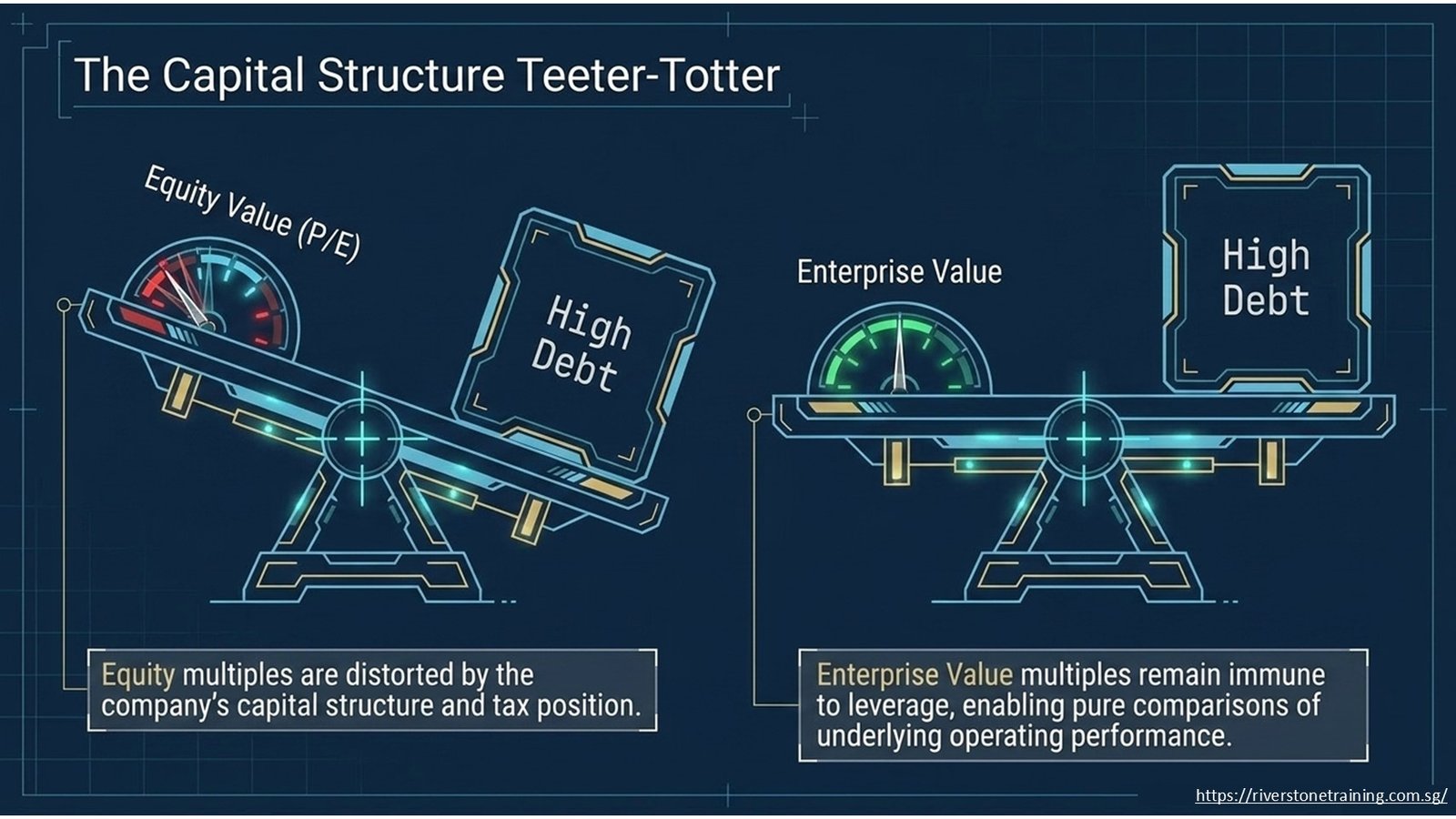
The two most widely used multiples of enterprise value are EV/EBITDA and EV/Revenue because they are not affected by the capital structure or tax position of the companies being compared. An equity value multiple such as the P/E ratio is used widely when comparing equity valuations based on earnings, in industries in which earnings are relatively stable. Balance sheet value is more important than price/Book in asset-intensive industries, like banking or real estate, and is therefore used less often in those industries.
Business valuation Courses instruct students to use multiples depending on the characteristics of the target business instead of a predetermined multiple. For a high-growth technology company that is not currently profitable, for instance, EV/Revenue might be more appropriate than EV/EBITDA. The appropriate choice of multiples depends on the specific context and is a skill that needs to be practised over a number of different industries and company profiles.
| Multiple | Primary Use |
| EV/EBITDA | Compare operating performance across peers |
| EV/Revenue | Value high-growth or low-profit businesses |
| P/E Ratio | Compare earnings-based equity valuations |
| Price/Book | Assess asset-intensive companies |
How Do Analysts Collect Comparable Company Data?
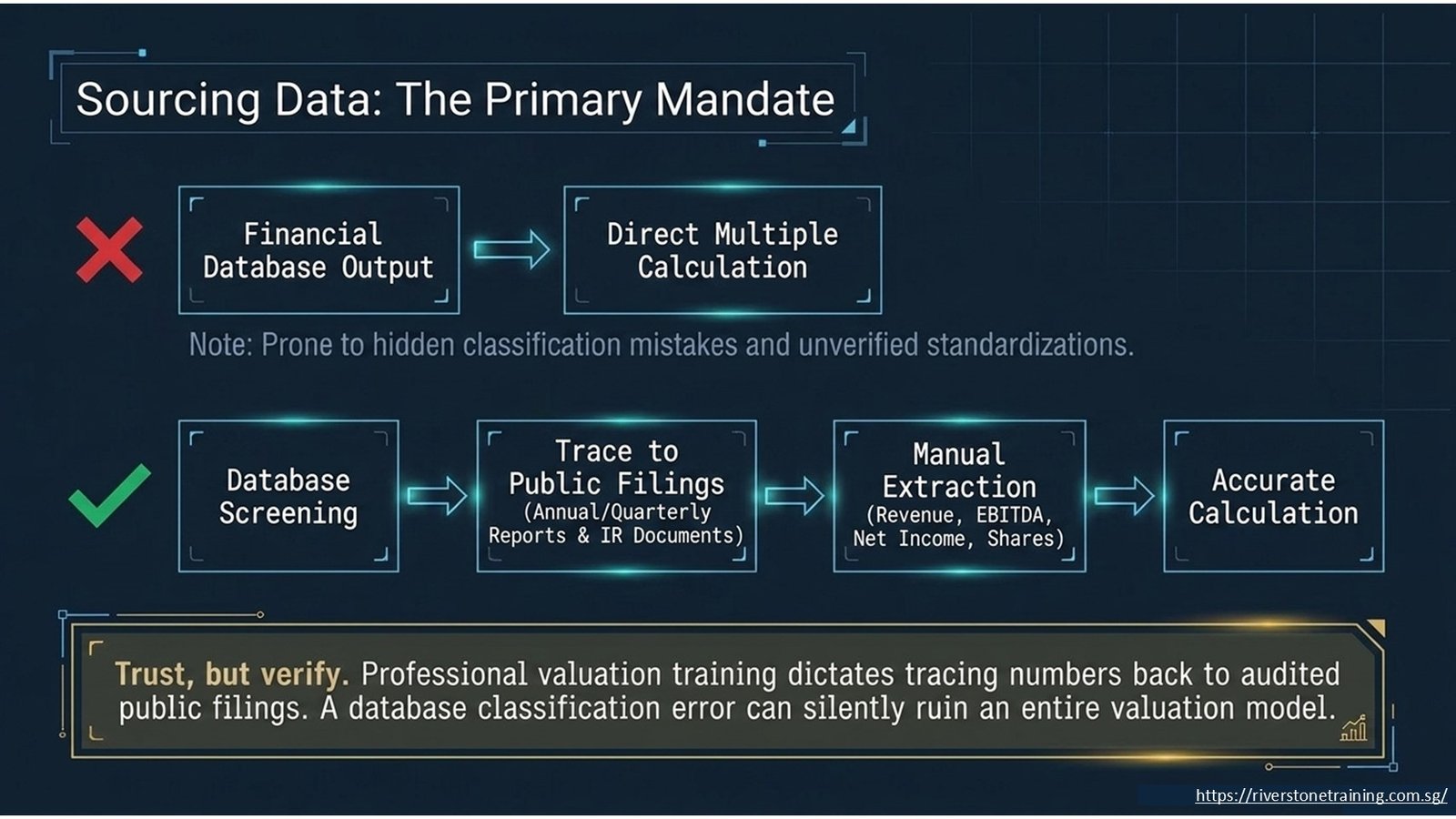
Analysts extract similar information from public filings and other financial data sources, including revenue, EBITDA, net income, share price, and shares outstanding, from company investor relations documents. Annual and quarterly reports for public peers give the audited financial detail that enables an accurate computation of multiples. Business valuation courses instruct students to follow up the numbers to the source rather than just the database outputs, as there are sometimes classification mistakes in the database.
In addition to accuracy, consistency of data collection is important because when the trailing twelve months data are compared to the forecast data of another company, a confusing multiple is produced. The time period, the currency and the accounting procedures are standardized across the peer group before the comparisons are made. This sort of attention to detail is a recurring theme in professional valuation training, and the minute inconsistencies add up to big valuation mistakes.
What Adjustments Improve Valuation Accuracy?
Normalising adjustments remove one-off items like litigation settlements, asset disposals or restructuring charges from the reported earnings to provide a more accurate valuation of the underlying operating performance of a company, as opposed to a single year of earnings. Comparability is further improved by the adjustment for differences in accounting policy, for example how some of the costs are capitalised. These adjustments are taught in great detail in business valuation courses, as they are one of the most common places for valuation errors to begin.
A few other things that may need adjusting prior to consistently applying a multiple are minority interest, non-operating assets, and acquisitions that have been made in the past. For example, if a company has recently acquired a large company, the analyst must determine what to do about the partial-year revenue and EBITDA from the acquired company. The ability to make and defend these adjustments is a part of good valuation judgment.
How Does Comparable Company Analysis Compare with DCF Valuation?
Comparable company analysis is based on current market valuations of similar companies, and discounted cash flow analysis is a method of determining a company’s intrinsic value by taking its future cash flows and discounting them back to the present. The two methods are used to answer different questions: What are people willing to pay for similar businesses, versus what is this particular business worth based on its own expected performance. Professional valuations will usually employ both methods and not either one or the other.
Business valuation courses instruct students how to interpret variations in the two outputs and not that one is necessarily right. For instance, if a comparable company analysis yields a higher value than a DCF model, it could potentially indicate that the market is valuing growth that the DCF model doesn’t account for, or that the comparable company group contains companies with different risk profiles. Addressing these discrepancies is one of the fundamental analytical abilities of corporate finance.
| Method | Best Used For |
| Comparable Company Analysis | Market-based, relative valuation |
| DCF Analysis | Intrinsic, cash-flow-based valuation |
| Precedent Transactions | Pricing benchmarks for acquisitions |
| Asset-Based Valuation | Asset-intensive or distressed businesses |
What Common Mistakes Should Analysts Avoid?
Analysts need to be careful not to pick a peer group strictly on industry classification, as it can lead to a discrepancy in size, growth, and profitability, resulting in misleading multiples. Another common mistake is the use of equity value multiples as well as enterprise value multiples, or using a multiple to the incorrect financial base, which causes significant differences. The outliers in a peer group can also affect the range of valuations, and an unusually high or low multiple in an average could also be considered an outlier.
A further common error is to not normalize for one-off items or accounting differences, as this will assume that the figures in question are unusual operating performance. Business valuation courses directly address these mistakes in the form of case studies that present faulty information, and the student is expected to recognize the fault and fix it. It’s a hands-on approach to develop attention to detail, which is required in professional valuations.
How Is Comparable Company Analysis Used in Mergers and Acquisitions?
Comparable company analysis is applied to define a valuation range in the context of mergers and acquisitions, both as part of the buy-side and sell-side valuation process. The investment bankers provide similar company multiples, precedent transaction analysis, and DCF output in a valuation football field for deal parties to use as a visual range to anchor negotiations. Such a mix of approaches enhances the credibility of the valuation that is offered to Boards and investment committees.
M&A advisors also use comparable company analysis to sense-check a proposed purchase price against how the market values similar public companies, which helps identify whether a deal is priced at a premium or discount to peers. This check is typically performed prior to showing the transaction to stakeholders for their approval.
How Do Practical Case Studies Improve Valuation Skills?
The practical case studies assist in developing valuation skills by asking learners to make decisions that are necessary for real-life assignments, not just follow a formula. Practicing on real companies’ financial statements to choose peers, work out multiples, and justify a value conclusion gives confidence that is not gained through theory alone. Business valuation courses present these case studies as realistic situations; for example, what if you were to value a medium-sized, privately-owned business for a sale process?
Case studies also provide an opportunity for the learner to learn other ways of thinking and doing something different from his/her own thoughts and actions. A learner who chose a limited, conservative peer group could show another learner who chose a wider range how the final range of valuations changes as a result of the different peer group selections. This comparative discussion is similar to the type of collaborative review process that is used with professional valuation teams.
What Career Opportunities Require Comparable Company Analysis?
A necessary competency in investment banking, private equity, corporate development, equity research, and business valuation advisory, as it is often called into service for deal work, research reports, and valuation opinions. The technique is used routinely by accountants and financial professionals in the context of financial reporting valuations, including purchase price allocation. In a way, business owners and management teams can benefit from knowing how the method works without actually having to do it themselves, as it will affect how their business is valued by outside parties.
Those finance majors who are going into these areas are generally looked upon to have similar abilities in company analysis, and they are expected to do so in their first few months on the job. Structured business valuation training provides graduates with an edge, developing this competency prior to applying it in an active deal. One of the most transparent practical benefits of the formal education on valuation is this preparation.
Why Is Continuous Practice Important for Valuation Professionals?
It is also crucial to practice regularly as valuation multiples, market conditions, and industry norms continually change; skills acquired in the initial training phases must be used regularly to remain current and sharp. If an analyst did a full comparable company analysis last year and hasn’t done it since, he will be slower and less confident in performing it than the monthly analyst will. Practice also helps develop pattern recognition with respect to reasonable multiples in various sectors.
Markets change, and peer groups that made sense two years ago may not be relevant today when the business model has changed, the company has merged, or it has entered a new market. Periodic reanalysis by valuation professionals helps them identify such changes in the lead-up to unwarranted conclusions. This is a continuous training discipline that many valuation professionals must master in order to distinguish themselves from other valuation professionals with only basic training.
How Can Business Valuation Courses Build Long-Term Expertise?
Business valuation courses develop over time and incorporate a structured introduction of theory, a consistent application of theory in a variety of case studies across multiple industries and business sizes, and a variety of business valuation scenarios. The capability is built step-by-step, from guided worked examples to independent case studies and then to more complex situations where there is normalisation adjustment or cross-border comparisons. This staged approach is reflective of on-the-job development of valuation skills.
Courses with feedback from professional instructors are also faster to build expertise because they correct incorrect thinking before it becomes ingrained. Students who are provided with detailed information about their peers’ selections and multiple applications will attain the level of competency in the profession more quickly than students who are not involved in these processes. A well-designed and well-rewarded curriculum and sound advice from qualified professionals are the reasons that formal training is a practical means to gain expertise in valuation.
Conclusion
The table below summarises the core skills covered in this article and how each one supports reliable comparable company analysis.
| Skill Area | Contribution to Valuation Accuracy |
| Peer Selection | Ensures comparisons reflect similar risk and growth profiles |
| Enterprise Value Calculation | Provides a consistent basis for applying multiples |
| Multiple Selection | Matches the valuation method to company characteristics |
| Data Normalisation | Removes distortions from one-off items and accounting differences |
| Case Study Practice | Builds judgement through real-world application |
Business valuation courses are taught using structured theory and practice: students develop the skills to choose the right company to compare, to use valuation multiples the right way, and to calculate the wrong enterprise value correctly. The key to a technically correct analysis that becomes a reliable business valuation is careful interpretation and application of market data rather than applying formulas.
Structured business valuation training builds these practical analytical abilities using real-life case studies, providing learners with the confidence to do analyses of similar companies in corporate finance, investment banking, and M&A. To build this skill set, it requires continued practice, and thus, both professionals and finance graduates can strengthen their expertise by continuing to practice these skills in real-world financial analysis and structured business valuation education.