How Do Business Valuation Courses Teach EBITDA Multiple Valuation?

In business valuation courses, students learn how to value businesses based on EBITDA, including how to analyze financial statements, calculate EBITDA for a business, choose the right valuation multiples, properly compare market data, and interpret the results along with other methods of valuation. After an in-depth guide to the EBITDA multiple valuation methodology, students develop their judgment and practical application skills to confidently use the methodology in real business situations. 

What Is the EBITDA Multiple Valuation Method?

The EBITDA multiple valuation method is a valuation approach that involves multiplying the company’s earnings before interest, taxes, depreciation and amortization by a valuation multiple derived from the market. This uses a company’s operating profitability to arrive at an estimate of value that is defensible through comparisons to similar transactions and/or publicly traded companies. 

Business Valuation Methods Comparison

Valuation Method Best Used For
EBITDA Multiple Profitable operating businesses with market comparables
Income Approach Businesses with predictable future cash flow
Market Approach Companies with strong comparable transaction data
Cost Approach Asset-intensive or early-stage businesses

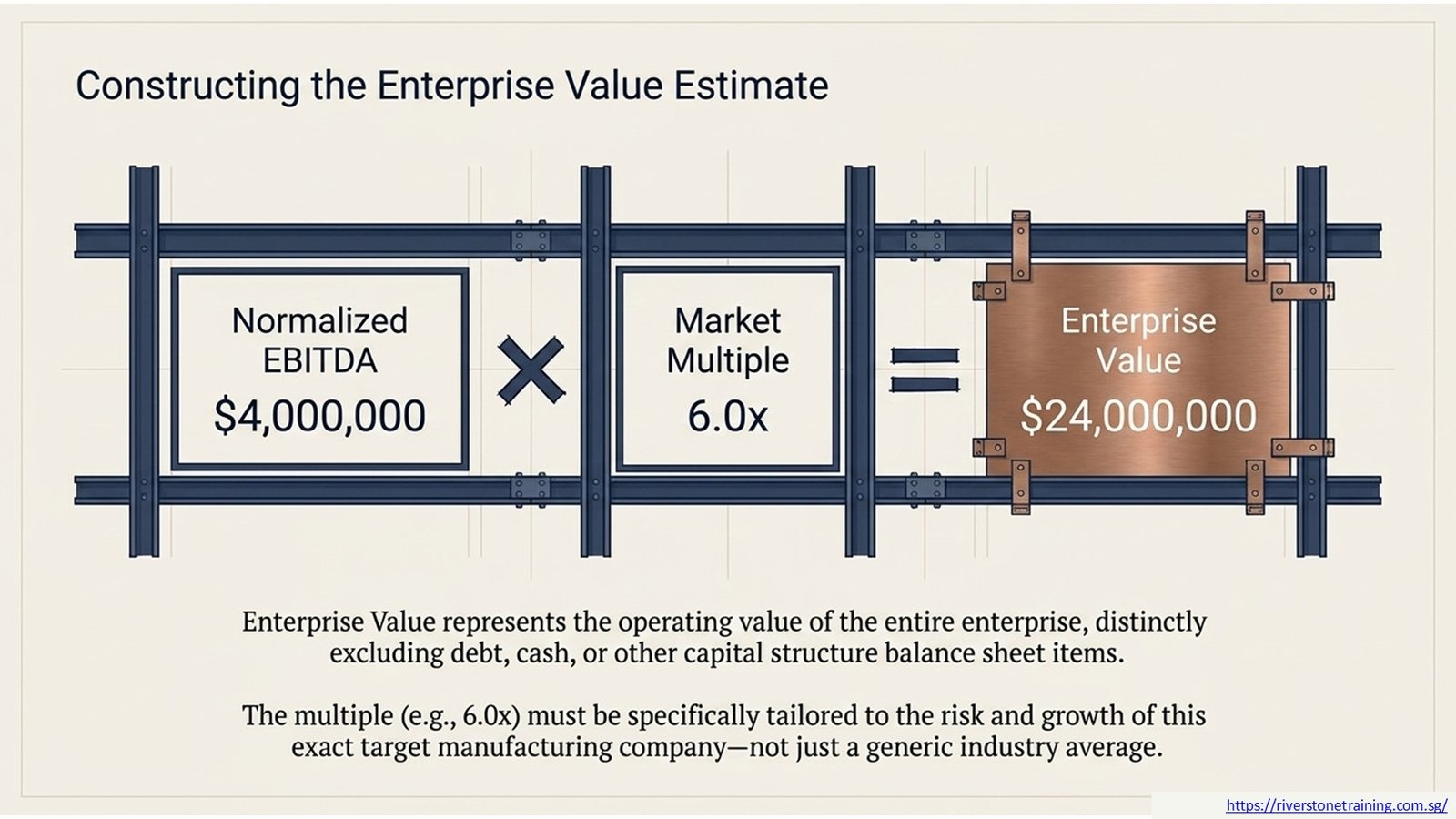
If a manufacturing company has normalized earnings before interest, taxes, depreciation, and amortization of $4 million and is worth 6 times its EBITDA, then its enterprise value, excluding debt and cash, would be $24 million. Price analysts who use this technique are taught how to choose multiples that are specific to the risk and growth of the target, not the industry. 
EBITDA Multiple Valuation

Why Is EBITDA Commonly Used in Business Valuation?

Because it removes financing structure, tax jurisdiction, and non-cash accounting charges, EBITDA is widely used in business valuation to give analysts a like-for-like basis for comparing the operating performance of companies. This is particularly helpful when comparing the businesses that have different capital structures or depreciation policies.

In leveraged transactions, EBITDA is a good proxy for cash operating profit; as such, it is also a good indicator of debt servicing capacity. The focus of valuation training is to get a handle on how to recognize the good and the bad of EBITDA, because oftentimes it can overestimate cash flow for capital-intensive companies with high reinvestment requirements. 

How Is Normalized EBITDA Calculated?

Normalized EBITDA is reported operating earnings after excluding non-recurring items, owner-specific expenses and accounting anomalies that are known to affect the true operating performance of a company. Typical deductions are one-off legal settlements, above-market owner compensation and non-operating asset gains or losses. 

EBITDA Multiple Valuation Process

Step Purpose
Calculate EBITDA Measure core operating performance
Normalize Earnings Remove one-off and owner-specific items
Select Multiple Reflect market conditions and company risk
Estimate Enterprise Value Determine total business value
Bridge to Equity Value Adjust for debt and cash

If a retail business owner pays themselves an above-market salary, for instance, then there is a need to make a compensation adjustment to account for what a professional manager would actually cost. Courses that include normalization guide students through the process of examining multiple years of financial statements to recognize these systematically, instead of just superficially. 

How Are EBITDA Multiples Selected?

EBITDA multiples are chosen by looking at similar transactions of other companies, and public trading multiples for companies within the target company’s industry, and making adjustments for size, growth, margin, and risk. A range of multiples is normally constructed by analysts as opposed to a single data point.

If a smaller, regional company has concentration risk and can’t be as deeply managed as a larger / more diversified company, it may be worth a discount to the multiples that the larger / more diversified company would receive. Valuation training focuses on learning multiple selection over a period of time with real deals and historical data, which are more judgmental aspects. 

How Do Comparable Companies Influence Valuation?

Other companies have a similar impact on valuation by providing a benchmark, based on the market, to apply to the target’s EBITDA, using transaction or trading data, not theoretical assumptions, to base the valuation on. Choosing a comparable set is very important as it is very easy to be misled by a mismatched set of peers, which would bias the value estimate.

Comparables are selected and screened on a number of different criteria, such as industry classification, revenue size, geographic coverage, growth path, etc., before a peer group is finalized. Comparable company analysis is an integral component of most valuation courses, and it necessitates both the ability to conduct a database analysis and a good commercial sense regarding the selection of appropriate comparison companies. 

What Factors Affect EBITDA Multiples?

The industry growth prospects, profitability margins, concentration of customers, competitive positioning and market conditions, including interest rates and deal activities, all influence EBITDA multiples. Companies that have a recurring revenue model tend to have higher valuations than those that depend on project-based or cyclical revenues.

Factors Affecting EBITDA Multiples

Factor Impact on Valuation
Industry Growth Higher growth may increase multiples
Profitability Strong margins support higher valuations
Business Risk Higher risk lowers multiples
Customer Concentration High concentration reduces multiples
Market Conditions Influences investor expectations and deal pricing

The higher a software firm’s customer retention and predictable subscription revenue, the higher its trading multiple will likely be when compared to a construction contractor with lumpy, project-driven earnings. These qualitative and quantitative drivers enable analysts to convey their conclusions on the valuation in a credible way to clients and deal counterparties. 

How Is Enterprise Value Calculated Using EBITDA?
EBITDA Multiple Valuation

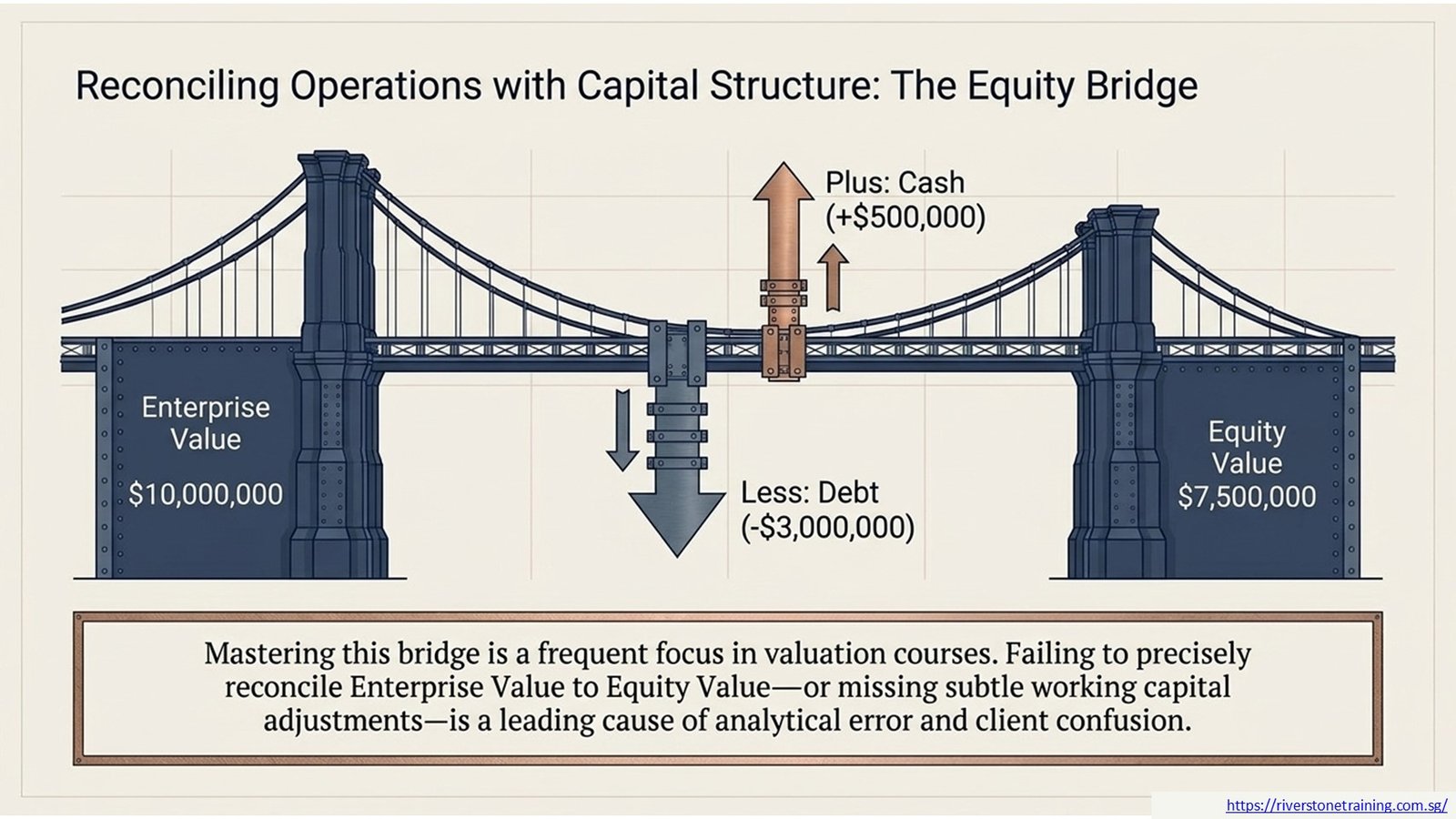
Then, enterprise value will be obtained by multiplying normalized EBITDA by the multiple, which will give an estimate of the enterprise’s operating value, excluding debt, cash, or other balance sheet items. Net debt is subtracted from enterprise value to get equity value.

A company with an enterprise value of $10 million, debt of $3 million, and cash of $500,000 would have an equity value of around $7.5 million. Learners have to do this bridge often times in valuation courses because it is an error that is a frequent cause of client confusion. 

When Is EBITDA Multiple Valuation Most Appropriate?

The EBITDA multiple is best suited to a profitable, established operating company with stable earnings and ample comparable market information to provide a valid selection of a multiple. It is suitable for companies that are in the process of being sold, acquired, or invested in, with the focus being market-based pricing.

It’s not as appropriate for early-stage companies that have negative or very low EBITDA, or for businesses that have a lot of assets that have an underlying value that is significantly higher than the value suggested by earnings-based multiples. Such boundaries are an essential part of one of the skills of judgment that is taught in applied valuation training, which is the recognition of such boundaries. 

How Does the Cost Approach Valuation Differ from EBITDA Multiple Valuation?

Cost approach valuation is an estimation of the value of a business based on the cost to replace or reproduce its underlying assets, as opposed to the earnings or market comparables. It’s usually employed for asset-intensive enterprises, holding companies, or when an enterprise has restricted or variable income. A structured cost approach valuation method is often applied alongside EBITDA multiples to cross-check results, especially when a company’s asset base is a significant driver of its overall worth.

For example, a real estate holding company that generates little in the way of operating income or cash flow, but has a significant amount of real estate assets, is more likely to be worth an EBITDA multiple rather than a cost or asset-based approach. During valuation training, students will learn to identify the appropriate course of action, or blending of courses of action, to a particular business profile. 

What Common Mistakes Should Analysts Avoid?

Analysts should not use industry averages without taking company-specific risk into account, non-normalized EBITDA with one-off items, and an inadequate set of comparables. These errors can lead to an over- or under-estimation of the real value of a business.

Less experienced analysts often miss the important, subtler details of working capital adjustments and do not reconcile enterprise value to equity value. Case training pops them into your face first and teaches them to look before they leap when making a valuation conclusion. 

How Do Business Valuation Courses Teach Practical Valuation Skills?

Business valuation courses will focus on the practical application of valuation principles by analyzing financial statements, engaging in realistic EBITDA normalization exercises, researching comparable companies, and completing multiple simulated company selections using actual or realistic company data. Normally, the learner will finish an entire valuation project, ranging from raw financial statements to a defensible price conclusion. An EBITDA multiple valuation method guide within the course curriculum helps learners understand EBITDA calculations, profitability analysis, and market-based valuation techniques step by step.

In addition to technical calculation, courses also develop report writing and client communication skills, as valuation conclusions must be clearly explained to the stakeholders, who may not have a finance background. This blend of technical and applied skills reflects the type of skills that employers are looking for in working valuation analysts. 

How Are Case Studies Used to Improve Valuation Skills?

Valuation skills are developed by using case studies, which present the learner with a realistic situation and cause them to collect financial information, choose the relevant method(s), and present their reasoning for their findings within a context that can be challenged. By solving a complete case, students will experience the same decisions they would make when working with the client.

For a family-owned distribution company, for example, a case study could involve normalizing owner compensation, choosing comparable companies, and comparing the EBITDA multiple and cost approach answers. Confident analysts develop their pattern recognition through repeated case practice. 

What Careers Require Business Valuation Expertise?

EBITDA Multiple Valuation

Any job that involves valuing a business or business interest requires business valuation expertise, such as a valuation specialist within investment banking, corporate finance, and M&A advisory, and accounting, or an independent valuation specialist. These abilities are immediately applicable to the needs of business owners who are planning for a business sale or succession planning. 

Career Applications of Business Valuation Skills

Role Valuation Application
Valuation Analyst Business appraisal and reporting
Investment Banker M&A advisory and deal pricing
Corporate Finance Manager Strategic planning and internal valuations
Financial Consultant Company valuation for owners and investors
Accountant Financial reporting and valuation support

For instance, a financial consultant working with a family business on succession planning would use the same EBITDA multiple and cost approach techniques as he would in a formal deal. This versatility of use extends far beyond the confines of special valuation houses. 

How Can Professionals Continue Developing Valuation Skills?

There are opportunities for professionals to build their valuation skills through ever-more complex “live” assignments, by keeping up with the data on market multiples, and by pursuing recognized valuation credentials that involve regular case-based assessment. Exposure to a range of industries helps to develop a better sense of judgment regarding appropriate methods and assumptions.

Once the valuation report is completed, the comparison of completed valuations to actual outcomes of transactions, if available, further aids analysts in adjusting over time their judgment regarding the selection and normalization of multiples. While structured training gives the foundation, sustained growth of skills is achieved by repetition of the training in real engagements. 

Why Is Professional Business Valuation Training Important?

Professional business valuation training is crucial because it builds the skills and expertise needed to apply the theoretical concepts of the valuation formula to the practical application of applying the formula and making a defensible and credible valuation conclusion. Employers and clients do not want analysts to simply put numbers into a formula; they want to see the reasoning behind their calculations. 

Summary: EBITDA Multiple Valuation at a Glance

Valuation Element Key Takeaway
EBITDA Normalization Removes distortions to reveal true operating performance
Multiple Selection Reflects market data adjusted for company-specific risk
Method Comparison Cross-check results against cost or income approaches
Professional Training Builds applied judgment through case-based practice

Conclusion

Business valuation courses equip students with skills to analyze financial statements, calculate normalized EBITDA, identify the market multiples that are credible and be able to compare the results with other valuation techniques. This methodical and hands-on approach equips analysts with the skills to generate valuation conclusions that meet professional standards.

The sound EBITDA multiple valuation method guide teaches students the market-based valuation skills to use in most profitable operating businesses, and when a business’s assets, earnings profile, or stage of development requires a different valuation approach, understanding the cost approach valuation ensures that the most appropriate one is used.

Theoretical knowledge is insufficient to produce a reliable business valuation; it must be repeated through practical experience. Structured business valuation training with a blend of EBITDA multiple analysis, cost approach methodology, and real case study practice will be beneficial to readers who want to enhance their valuation skills. 
Frequently Asked Questions

What is EBITDA multiple valuation?

EBITDA multiple valuation is a method of valuing a company in which the normalised EBITDA is multiplied by a market-based multiple, based on comparable companies or transactions, to arrive at a company’s enterprise value. One of the most commonly used market-based methods of valuing profitable operating entities. 

The EBITDA multiple is determined by analysing trade multiples of companies in the same sector, size, growth and margin, and making adjustments for differences in risk associated with the company. Analysts generally construct a range and not a single number.

Cost approach valuation should be used in asset-intensive businesses, a holding company or a business with limited or unstable earnings in which an earnings-based multiple is not representative of true value. It is used in conjunction with EBITDA multiples as a check.

Business valuation courses cover the concepts of EBITDA normalization, comparable company research, multiple selection, enterprise-to-equity value bridging, and writing value reports. Learners also acquire the ability to make analytical judgments between valuation methods and to justify their findings. 

Not all businesses are appropriate to be valued using an EBITDA multiple. It’s best to use this valuation method for profitable businesses with established operations and good comparable data. The cost or income approach is typically more suitable for early-stage, asset-rich or income-poor businesses. 

Case studies enhance the accuracy of the valuation process by having students practice normalization, multiple selection and comparing methods in realistic company situations. Completion of full exercises develops pattern recognition to make informed judgment calls during real engagements.

In business valuation courses, students learn how to value businesses based on EBITDA, including how to analyze financial statements, calculate EBITDA for a business, choose the right valuation multiples, properly compare market data, and interpret the results along with other methods of valuation. After an in-depth guide to the EBITDA multiple valuation methodology, students develop their judgment and practical application skills to confidently use the methodology in real business situations. 

What Is the EBITDA Multiple Valuation Method?

The EBITDA multiple valuation method is a valuation approach that involves multiplying the company’s earnings before interest, taxes, depreciation and amortization by a valuation multiple derived from the market. This uses a company’s operating profitability to arrive at an estimate of value that is defensible through comparisons to similar transactions and/or publicly traded companies. 

Business Valuation Methods Comparison

Valuation Method Best Used For
EBITDA Multiple Profitable operating businesses with market comparables
Income Approach Businesses with predictable future cash flow
Market Approach Companies with strong comparable transaction data
Cost Approach Asset-intensive or early-stage businesses

If a manufacturing company has normalized earnings before interest, taxes, depreciation, and amortization of $4 million and is worth 6 times its EBITDA, then its enterprise value, excluding debt and cash, would be $24 million. Price analysts who use this technique are taught how to choose multiples that are specific to the risk and growth of the target, not the industry. 

EBITDA Multiple Valuation

Why Is EBITDA Commonly Used in Business Valuation?

Because it removes financing structure, tax jurisdiction, and non-cash accounting charges, EBITDA is widely used in business valuation to give analysts a like-for-like basis for comparing the operating performance of companies. This is particularly helpful when comparing the businesses that have different capital structures or depreciation policies.

In leveraged transactions, EBITDA is a good proxy for cash operating profit; as such, it is also a good indicator of debt servicing capacity. The focus of valuation training is to get a handle on how to recognize the good and the bad of EBITDA, because oftentimes it can overestimate cash flow for capital-intensive companies with high reinvestment requirements. 

How Is Normalized EBITDA Calculated?

Normalized EBITDA is reported operating earnings after excluding non-recurring items, owner-specific expenses and accounting anomalies that are known to affect the true operating performance of a company. Typical deductions are one-off legal settlements, above-market owner compensation and non-operating asset gains or losses. 

EBITDA Multiple Valuation Process

Step Purpose
Calculate EBITDA Measure core operating performance
Normalize Earnings Remove one-off and owner-specific items
Select Multiple Reflect market conditions and company risk
Estimate Enterprise Value Determine total business value
Bridge to Equity Value Adjust for debt and cash

If a retail business owner pays themselves an above-market salary, for instance, then there is a need to make a compensation adjustment to account for what a professional manager would actually cost. Courses that include normalization guide students through the process of examining multiple years of financial statements to recognize these systematically, instead of just superficially. 

How Are EBITDA Multiples Selected?

EBITDA multiples are chosen by looking at similar transactions of other companies, and public trading multiples for companies within the target company’s industry, and making adjustments for size, growth, margin, and risk. A range of multiples is normally constructed by analysts as opposed to a single data point.

If a smaller, regional company has concentration risk and can’t be as deeply managed as a larger / more diversified company, it may be worth a discount to the multiples that the larger / more diversified company would receive. Valuation training focuses on learning multiple selection over a period of time with real deals and historical data, which are more judgmental aspects. 

How Do Comparable Companies Influence Valuation?

Other companies have a similar impact on valuation by providing a benchmark, based on the market, to apply to the target’s EBITDA, using transaction or trading data, not theoretical assumptions, to base the valuation on. Choosing a comparable set is very important as it is very easy to be misled by a mismatched set of peers, which would bias the value estimate.

Comparables are selected and screened on a number of different criteria, such as industry classification, revenue size, geographic coverage, growth path, etc., before a peer group is finalized. Comparable company analysis is an integral component of most valuation courses, and it necessitates both the ability to conduct a database analysis and a good commercial sense regarding the selection of appropriate comparison companies. 

What Factors Affect EBITDA Multiples?

The industry growth prospects, profitability margins, concentration of customers, competitive positioning and market conditions, including interest rates and deal activities, all influence EBITDA multiples. Companies that have a recurring revenue model tend to have higher valuations than those that depend on project-based or cyclical revenues.

Factors Affecting EBITDA Multiples

Factor Impact on Valuation
Industry Growth Higher growth may increase multiples
Profitability Strong margins support higher valuations
Business Risk Higher risk lowers multiples
Customer Concentration High concentration reduces multiples
Market Conditions Influences investor expectations and deal pricing

The higher a software firm’s customer retention and predictable subscription revenue, the higher its trading multiple will likely be when compared to a construction contractor with lumpy, project-driven earnings. These qualitative and quantitative drivers enable analysts to convey their conclusions on the valuation in a credible way to clients and deal counterparties. 

How Is Enterprise Value Calculated Using EBITDA?

EBITDA Multiple Valuation

Then, enterprise value will be obtained by multiplying normalized EBITDA by the multiple, which will give an estimate of the enterprise’s operating value, excluding debt, cash, or other balance sheet items. Net debt is subtracted from enterprise value to get equity value.

A company with an enterprise value of $10 million, debt of $3 million, and cash of $500,000 would have an equity value of around $7.5 million. Learners have to do this bridge often times in valuation courses because it is an error that is a frequent cause of client confusion. 

When Is EBITDA Multiple Valuation Most Appropriate?

The EBITDA multiple is best suited to a profitable, established operating company with stable earnings and ample comparable market information to provide a valid selection of a multiple. It is suitable for companies that are in the process of being sold, acquired, or invested in, with the focus being market-based pricing.

It’s not as appropriate for early-stage companies that have negative or very low EBITDA, or for businesses that have a lot of assets that have an underlying value that is significantly higher than the value suggested by earnings-based multiples. Such boundaries are an essential part of one of the skills of judgment that is taught in applied valuation training, which is the recognition of such boundaries. 

How Does the Cost Approach Valuation Differ from EBITDA Multiple Valuation?

Cost approach valuation is an estimation of the value of a business based on the cost to replace or reproduce its underlying assets, as opposed to the earnings or market comparables. It’s usually employed for asset-intensive enterprises, holding companies, or when an enterprise has restricted or variable income. A structured cost approach valuation method is often applied alongside EBITDA multiples to cross-check results, especially when a company’s asset base is a significant driver of its overall worth.

For example, a real estate holding company that generates little in the way of operating income or cash flow, but has a significant amount of real estate assets, is more likely to be worth an EBITDA multiple rather than a cost or asset-based approach. During valuation training, students will learn to identify the appropriate course of action, or blending of courses of action, to a particular business profile. 

What Common Mistakes Should Analysts Avoid?

Analysts should not use industry averages without taking company-specific risk into account, non-normalized EBITDA with one-off items, and an inadequate set of comparables. These errors can lead to an over- or under-estimation of the real value of a business.

Less experienced analysts often miss the important, subtler details of working capital adjustments and do not reconcile enterprise value to equity value. Case training pops them into your face first and teaches them to look before they leap when making a valuation conclusion. 

How Do Business Valuation Courses Teach Practical Valuation Skills?

Business valuation courses will focus on the practical application of valuation principles by analyzing financial statements, engaging in realistic EBITDA normalization exercises, researching comparable companies, and completing multiple simulated company selections using actual or realistic company data. Normally, the learner will finish an entire valuation project, ranging from raw financial statements to a defensible price conclusion. An EBITDA multiple valuation method guide within the course curriculum helps learners understand EBITDA calculations, profitability analysis, and market-based valuation techniques step by step.

In addition to technical calculation, courses also develop report writing and client communication skills, as valuation conclusions must be clearly explained to the stakeholders, who may not have a finance background. This blend of technical and applied skills reflects the type of skills that employers are looking for in working valuation analysts. 

How Are Case Studies Used to Improve Valuation Skills?

Valuation skills are developed by using case studies, which present the learner with a realistic situation and cause them to collect financial information, choose the relevant method(s), and present their reasoning for their findings within a context that can be challenged. By solving a complete case, students will experience the same decisions they would make when working with the client.

For a family-owned distribution company, for example, a case study could involve normalizing owner compensation, choosing comparable companies, and comparing the EBITDA multiple and cost approach answers. Confident analysts develop their pattern recognition through repeated case practice. 

What Careers Require Business Valuation Expertise?

EBITDA Multiple Valuation

Any job that involves valuing a business or business interest requires business valuation expertise, such as a valuation specialist within investment banking, corporate finance, and M&A advisory, and accounting, or an independent valuation specialist. These abilities are immediately applicable to the needs of business owners who are planning for a business sale or succession planning. 

Career Applications of Business Valuation Skills

Role Valuation Application
Valuation Analyst Business appraisal and reporting
Investment Banker M&A advisory and deal pricing
Corporate Finance Manager Strategic planning and internal valuations
Financial Consultant Company valuation for owners and investors
Accountant Financial reporting and valuation support

For instance, a financial consultant working with a family business on succession planning would use the same EBITDA multiple and cost approach techniques as he would in a formal deal. This versatility of use extends far beyond the confines of special valuation houses. 

How Can Professionals Continue Developing Valuation Skills?

There are opportunities for professionals to build their valuation skills through ever-more complex “live” assignments, by keeping up with the data on market multiples, and by pursuing recognized valuation credentials that involve regular case-based assessment. Exposure to a range of industries helps to develop a better sense of judgment regarding appropriate methods and assumptions.

Once the valuation report is completed, the comparison of completed valuations to actual outcomes of transactions, if available, further aids analysts in adjusting over time their judgment regarding the selection and normalization of multiples. While structured training gives the foundation, sustained growth of skills is achieved by repetition of the training in real engagements. 

Why Is Professional Business Valuation Training Important?

Professional business valuation training is crucial because it builds the skills and expertise needed to apply the theoretical concepts of the valuation formula to the practical application of applying the formula and making a defensible and credible valuation conclusion. Employers and clients do not want analysts to simply put numbers into a formula; they want to see the reasoning behind their calculations. 

Summary: EBITDA Multiple Valuation at a Glance

Valuation Element Key Takeaway
EBITDA Normalization Removes distortions to reveal true operating performance
Multiple Selection Reflects market data adjusted for company-specific risk
Method Comparison Cross-check results against cost or income approaches
Professional Training Builds applied judgment through case-based practice

Conclusion

Business valuation courses equip students with skills to analyze financial statements, calculate normalized EBITDA, identify the market multiples that are credible and be able to compare the results with other valuation techniques. This methodical and hands-on approach equips analysts with the skills to generate valuation conclusions that meet professional standards.

The sound EBITDA multiple valuation method guide teaches students the market-based valuation skills to use in most profitable operating businesses, and when a business’s assets, earnings profile, or stage of development requires a different valuation approach, understanding the cost approach valuation ensures that the most appropriate one is used.

Theoretical knowledge is insufficient to produce a reliable business valuation; it must be repeated through practical experience. Structured business valuation training with a blend of EBITDA multiple analysis, cost approach methodology, and real case study practice will be beneficial to readers who want to enhance their valuation skills. 

Frequently Asked Questions

What is EBITDA multiple valuation?

EBITDA multiple valuation is a method of valuing a company in which the normalised EBITDA is multiplied by a market-based multiple, based on comparable companies or transactions, to arrive at a company’s enterprise value. One of the most commonly used market-based methods of valuing profitable operating entities. 

The EBITDA multiple is determined by analysing trade multiples of companies in the same sector, size, growth and margin, and making adjustments for differences in risk associated with the company. Analysts generally construct a range and not a single number.

Cost approach valuation should be used in asset-intensive businesses, a holding company or a business with limited or unstable earnings in which an earnings-based multiple is not representative of true value. It is used in conjunction with EBITDA multiples as a check.

Business valuation courses cover the concepts of EBITDA normalization, comparable company research, multiple selection, enterprise-to-equity value bridging, and writing value reports. Learners also acquire the ability to make analytical judgments between valuation methods and to justify their findings. 

Not all businesses are appropriate to be valued using an EBITDA multiple. It’s best to use this valuation method for profitable businesses with established operations and good comparable data. The cost or income approach is typically more suitable for early-stage, asset-rich or income-poor businesses. 

Case studies enhance the accuracy of the valuation process by having students practice normalization, multiple selection and comparing methods in realistic company situations. Completion of full exercises develops pattern recognition to make informed judgment calls during real engagements.

Related Posts

Complete Guide Everything You Need to Know About Business Valuation Training

Learn Business Valuation in Singapore – Everything You Need to Know, Contact Us Now